
Vazha-Pshavela House Museum, Chargali
The two-room house in a Pshavi village where Luka Razikashvili became Vazha-Pshavela: his rifle, his sister’s saddlebag, and his mountains outside.
- Time needed
- 1 h
- From Tbilisi
- 89 km · 2:00
- Road
- Unpaved sections
- Car needed
- Crossover / SUV
- Season
- May–October
- Entry
- check locally
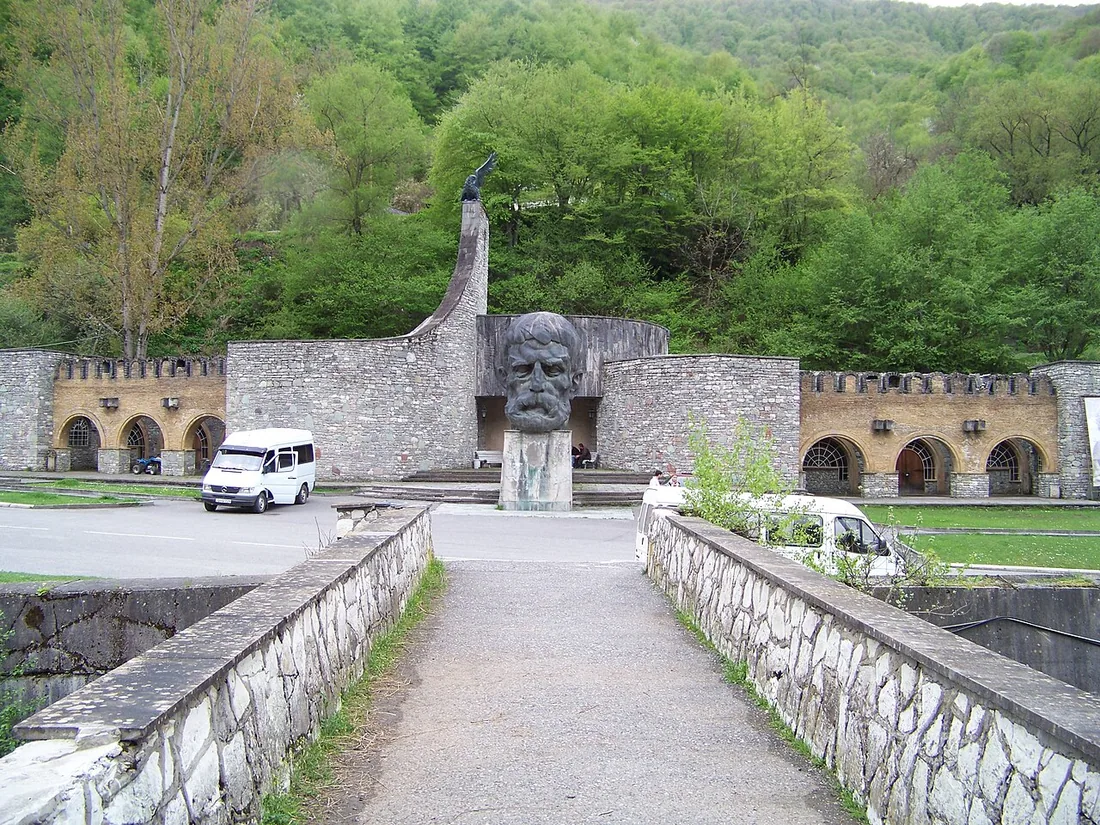
In a single-storey, two-room house in Chargali lived the poet Georgians call simply Vazha — and from here the mountains of Pshavi walked into Georgian literature.
Luka Razikashvili was born in Chargali on 14 July 1861 into a family of clergymen. An uncle gave him his love of forest and hunting, and the uncle himself later found his way into the poems. He graduated from the teachers’ seminary in Gori in 1882, audited law at St Petersburg University in 1883–84, ran out of money and came home to the mountains to teach Georgian and write. The output is enormous: 36 epic poems and some 400 lyrics, among them Aluda Ketelauri (1888), Bakhtrioni (1892), Host and Guest (1893) and The Snake-Eater (1901). In them the individual defies the community, and nature is alive and full of tension. The British scholar Donald Rayfield ranks him “qualitatively of a greater magnitude than any other Georgian writer”.
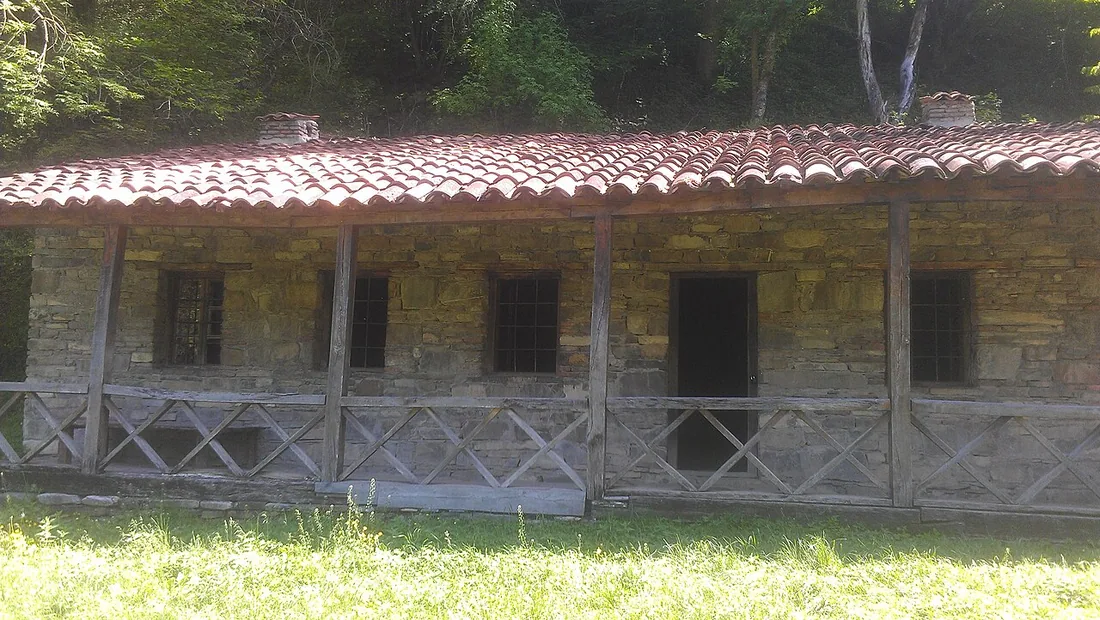
The museum and memorial opened in 1961. His room is almost bare: a table, a chair, a fireplace, and his rifle on the wall — Vazha was a practised hunter. Beside it hangs the saddlebag his sister Marta wove for him, in which he carried his belongings. The collection adds manuscripts, first editions, photographs, 19th- and 20th-century ethnographic objects, and paintings and sculpture made in his honour; in the yard stand outbuildings, an old-style oven and a mill. Every year the village holds its traditional festival, Vazhaoba.
Vazha died in Tbilisi on 10 July 1915 and lies in the Mtatsminda Pantheon. The grave is in the capital, but the forest that speaks in his poems begins just beyond this gate.
Gallery
Practical advice
Most important: Georgia’s Ministry of Culture has announced a full 2025–2027 rehabilitation of the museum — building works, conservation and a new exhibition. No source confirms whether it stays open during the work, so phone ahead before driving out, and confirm the entry fee at the same time. An hour is enough inside. The village is small; do not count on a café, and bring water and food. After October snow and mud make the valley road harder, so May to October is the sensible window.
How to get there from Tbilisi
From Tbilisi take the Georgian Military Highway (E117, S3) to Zhinvali, then turn onto the Zhinvali–Barisakho–Shatili road (Sh26) and follow the Pshavi Aragvi valley for about 30 km. Do not go as far as Barisakho: a short spur road (Sh145) branches off to Chargali, roughly three more kilometres to the village. In total it is 89 km and about two hours. The valley road is patchy in places and the final stretch is narrow gravel, so an SUV is the better choice even in dry weather. Refuel in Zhinvali. The museum has its own yard, with a level walk from where you park.
Click a marker for details. Coloured lines are ready-made road trips.
Nearby places
Barisakho
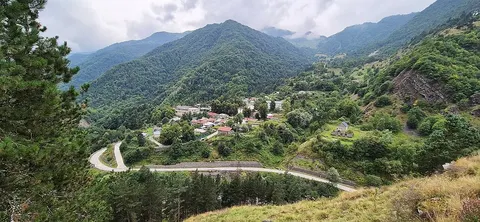
The gateway village of Khevsureti on the Aragvi: guesthouses, a hot meal and a long memory before the road turns into a 4x4 track.
Pasanauri and the Aragvi Confluence
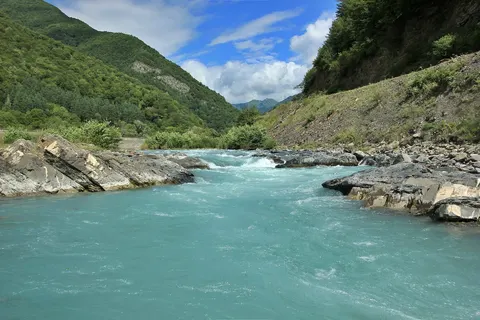
The old heart of Mtiuleti, where the White and Black Aragvi meet in two colours and khinkali are treated as a matter of local honour.
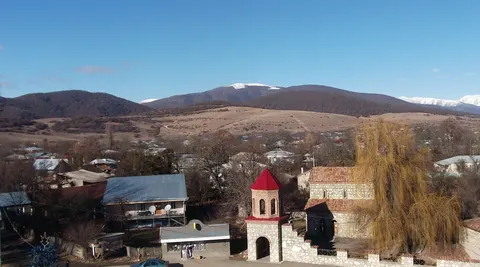
Tianeti
A cool upland basin on the upper Iori where Kakhetian rulers once held court, with a reservoir over drowned villages and Bochorma fortress downriver.
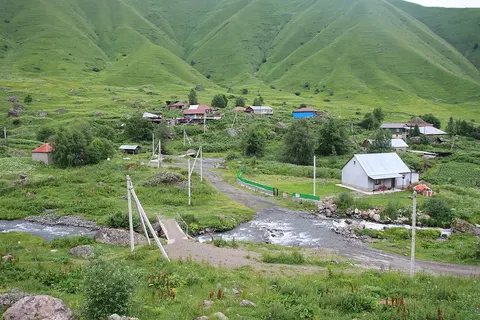
Roshka
A stone village of Khevsureti at 2,000 m under the teeth of Chaukhi, with house-sized glacial boulders above it and the Abudelauri lakes beyond.
Best car for this trip
Unpaved sections
Guides
- Do You Need a 4x4 in Georgia? We rate the road surface and the minimum car class for all 267 places in our database. 227 of them need nothin
- Winter Driving in Georgia: What Closes, What Opens, Which Car Of the 267 places we map, 161 are in season in winter and 52 are flagged as not reachable year-round. The pass
Pickup locations
Car Rental in Tbilisi — 71 km (straight line)
Booking and enquiries
The easiest way to reach these places is by car — you pick the route and the stops.