
Tsromi Church
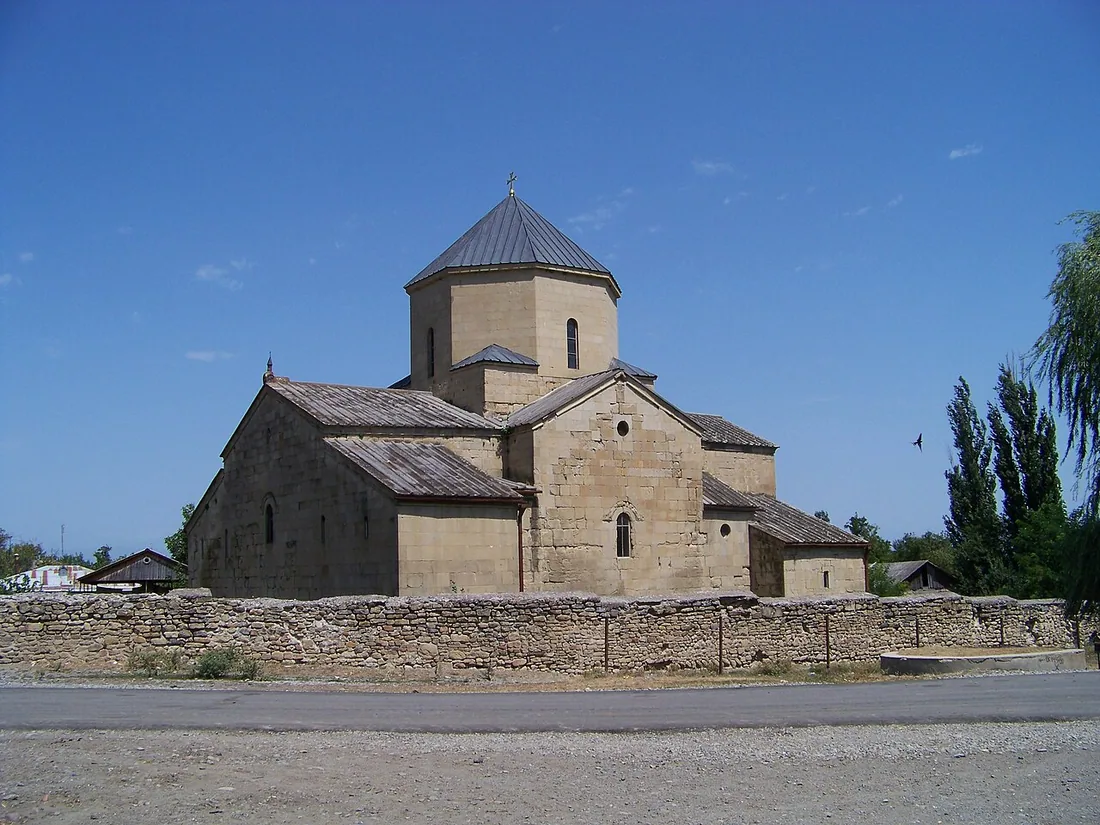
Built in 626–634 for Prince Stepanoz II, Tsromi was the first Georgian church to raise its dome on four free-standing piers.
- Time needed
- 1 h
- From Tbilisi
- 122 km · 1:40
- Road
- Paved
- Car needed
- Economy class
- Season
- All year
- Entry
- free
Before Tsromi, Georgian domes leaned on walls; after it, they stood on four free piers, and the country's churches never went back.
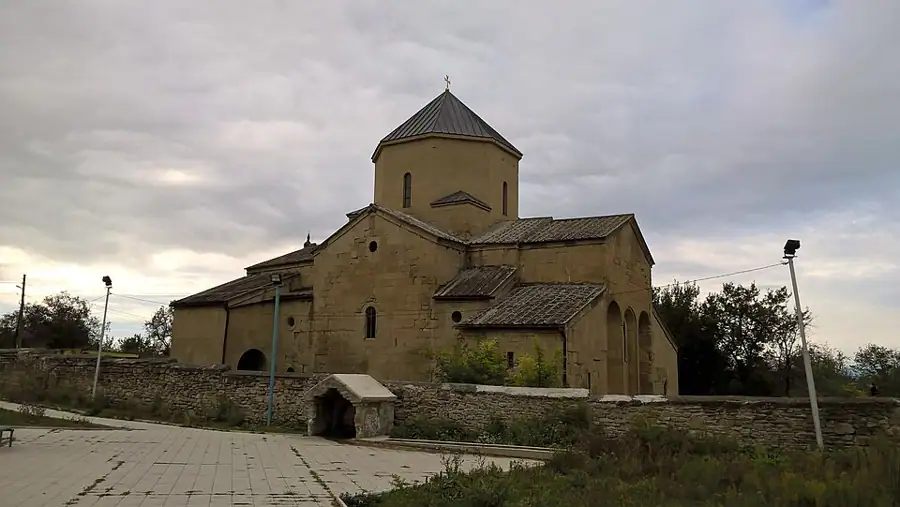
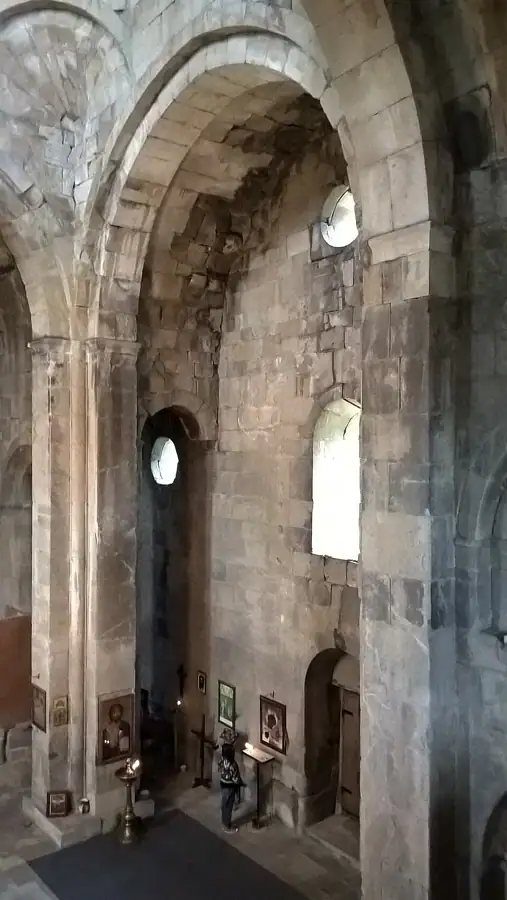
An inscription on the south façade names the patron, Stepanoz II, prince of Kartli and son of Adarnase, and the church is dated to 626–634. The plan is an equal-armed cross drawn inside a rectangle. At its centre four free-standing piers carry an octagonal drum, and four great squinches turn the square into the octagon. Art historians pair it with Jvari at Mtskheta as a founding monument of Georgian church building. The east façade shows another first: two deep triangular niches flanking the apse, a device builders would repeat for centuries.
The ground was holy before the stone. The Georgian chronicle tradition says an older church stood here, and that in August 457 Razhden, who had become a Christian in the days of King Vakhtang Gorgasali, was martyred at Tsromi.
On 8 May 1940 an earthquake brought down the dome and much of the vaulting, and tilted the west wall. Restorers started in 1949, pulled the wall upright in 1959 and in 1974–75 rebuilt the squinches under a trial timber dome. Today the church stands whole again under its drum and tiled roof.
The apse once held a seventh-century mosaic: Christ in glory, approached by two figures read as Peter and Paul, on a ground of gold tesserae with red, black and pale green stone. The surviving fragments went to the Art Museum of Georgia in Tbilisi in the 1930s; in the conch only the lines of the preparatory drawing remain.
So read the walls instead: dressed sandstone, flecked with dark grey and yellowish porphyrite, laid in courses so straight they look ruled. Every Georgian dome you meet after this is, in some measure, an heir of these four piers.
Gallery
Practical advice
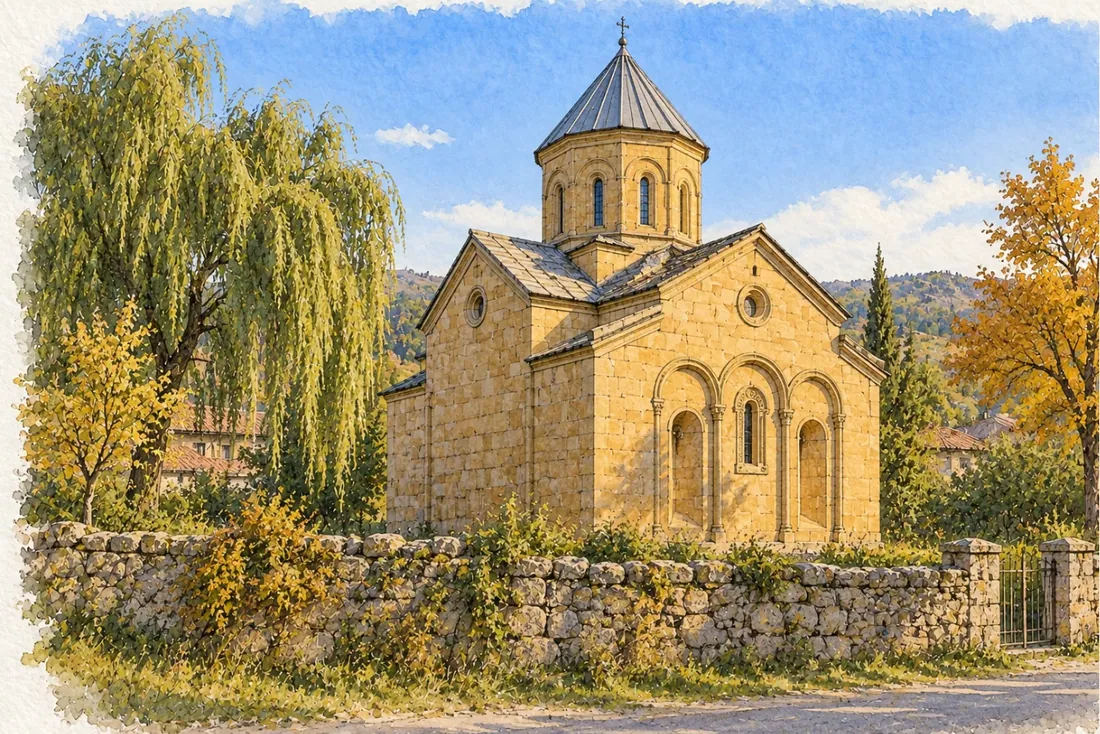
Allow 45 minutes to an hour. Tsromi is a working church: cover shoulders and knees, and women will want a headscarf. If the door is shut, walk round to the east end — the triangular niches and the triple arcade are the real lesson here and need no key. Morning sun falls straight on that façade, so come early for photographs. The village has no café; eat in Khashuri or Gori and carry water. Samtsevrisi and Kintsvisi are both close, and the three together make a fine day of early Kartli.
How to get there from Tbilisi
From Tbilisi take the S1 (E60) motorway west past Gori and Kareli, about 115 km of fast dual carriageway. Just short of Khashuri leave the motorway for Gomi on the old road (Sh203); from Gomi a local road runs south for the last three kilometres or so into Tsromi; the church stands in the middle of the village on the right bank of the Mtkvari. Around 122 km and 1 hour 40 minutes in all. Asphalt the whole way, though the village lane is narrow with a couple of blind bends. Fuel in Gori or Khashuri. Free parking by the churchyard wall; an economy car is all you need.
Click a marker for details. Coloured lines are ready-made road trips.
Nearby places
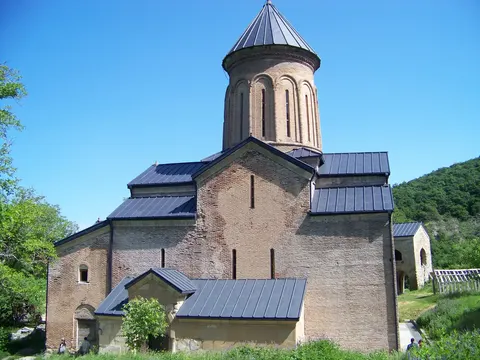
Kintsvisi Monastery
A red-brick Golden Age church in the forest near Kareli, where an angel in lapis-lazuli blue points to Christ's empty tomb.
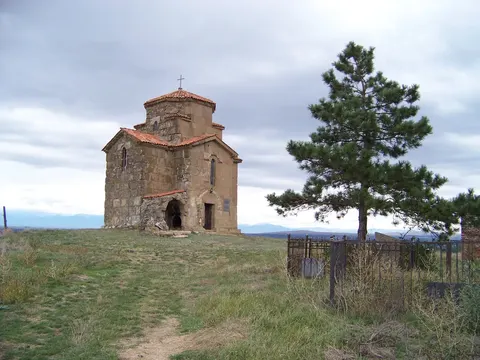
Samtsevrisi Church of St George
A 7th-century free-cross church barely eleven metres tall that still commands the plain where the Dzama meets the Mtkvari.
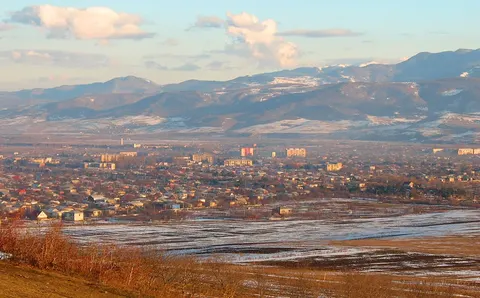
Khashuri
A railway town on the western rim of Shida Kartli, where the main road splits: south to Borjomi, west over the Rikoti pass to the sea.
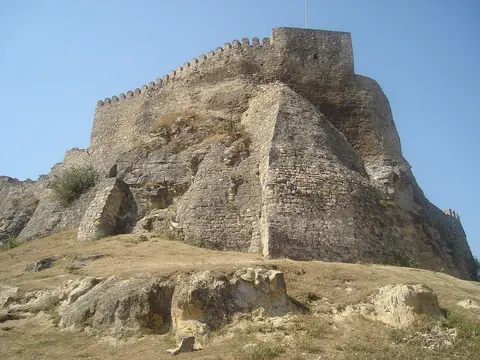
Surami Fortress
A citadel on a rock at the old fork of the roads west over the Likhi range and south to Borjomi, home to one of Georgia's best-known legends.
Best car for this trip
Guides
- Driving in Georgia: What the Distances Actually Cost You Georgia is a small country with slow roads. Here is what 267 measured drives from Tbilisi say about how long y
Pickup locations
Car Rental in Kutaisi — 90 km (straight line)
Booking and enquiries
The easiest way to reach these places is by car — you pick the route and the stops.