
Samtsevrisi Church of St George
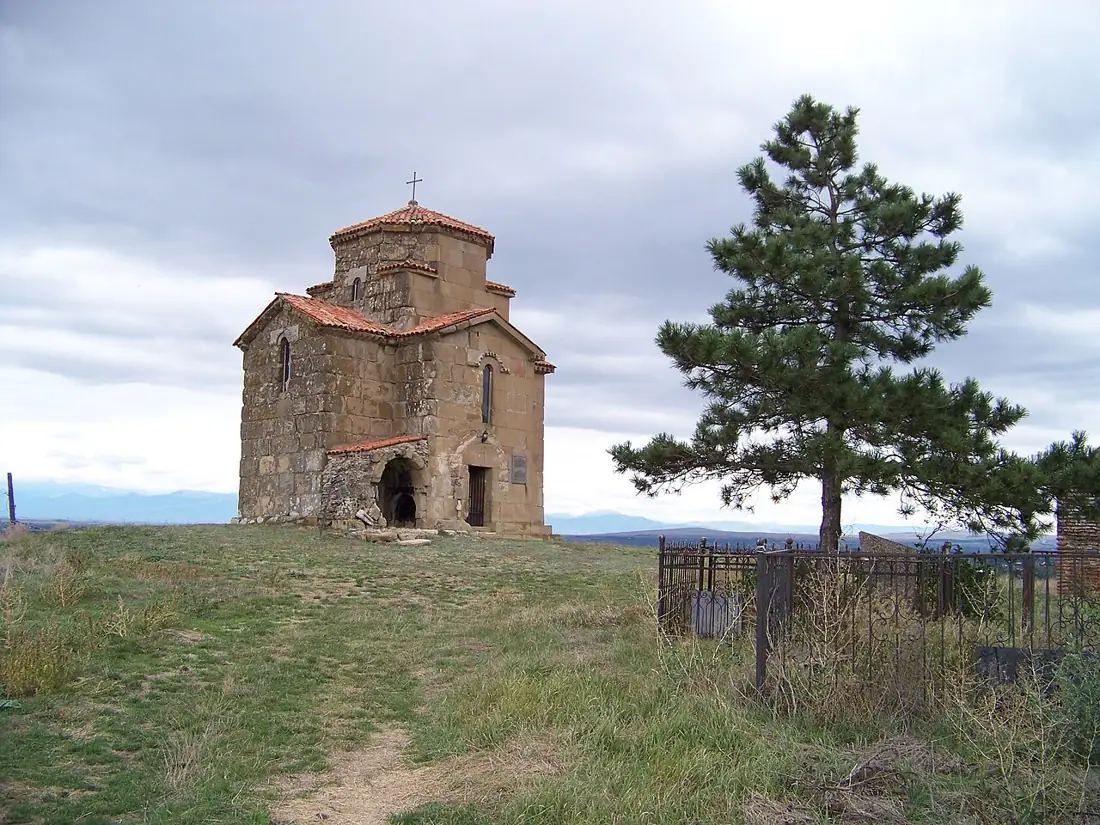
A 7th-century free-cross church barely eleven metres tall that still commands the plain where the Dzama meets the Mtkvari.
- Time needed
- 1 h
- From Tbilisi
- 111 km · 1:30
- Road
- Mostly paved
- Car needed
- Economy class
- Season
- All year
- Entry
- free
Samtsevrisi stands barely eleven metres tall, yet it commands a whole plain — proof that in architecture proportion beats size.
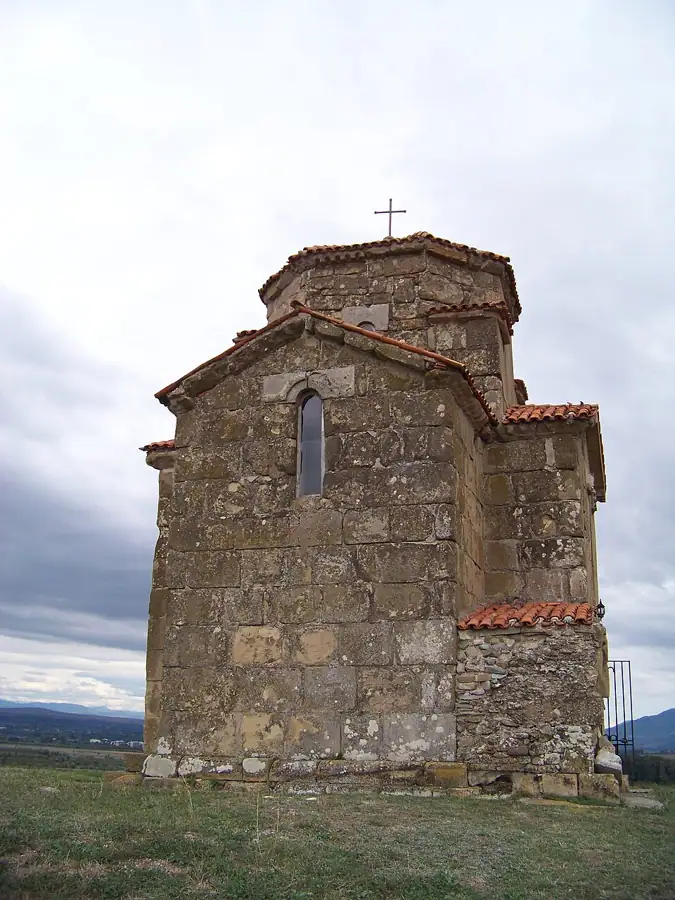
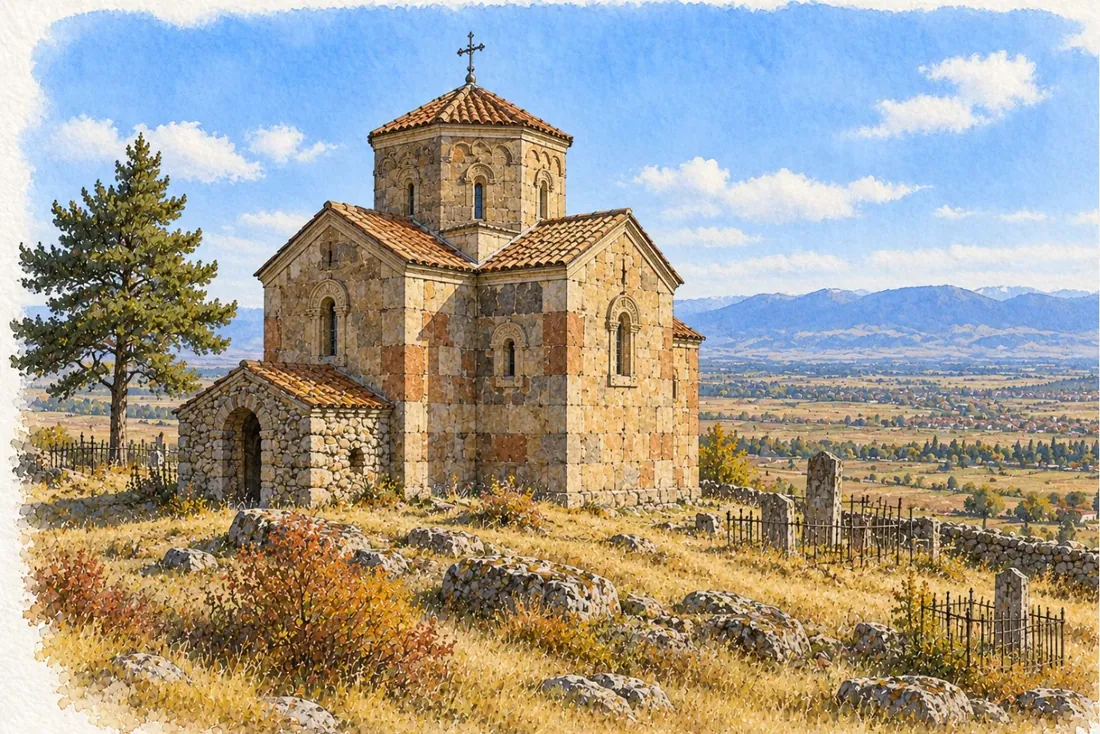
The church of St George stands on a low hill on the left bank of the Dzama, at the eastern tip of the plateau between the Dzama and Mtkvari valleys, and you can pick it out from the motorway and railway to the north. It is dated by its style to the first half of the 7th century and is a textbook free cross: four short arms around a central square, a horseshoe apse to the east, nothing more. The whole building is 9.6 by 8.8 metres and 10.6 metres tall.
What makes it sing is the dome. Four large squinches and eight smaller ones step the square up into an octagon, and the drum rides on them. The greyish-red sandstone is left almost bare; the only ornament is the carved framing round the windows.
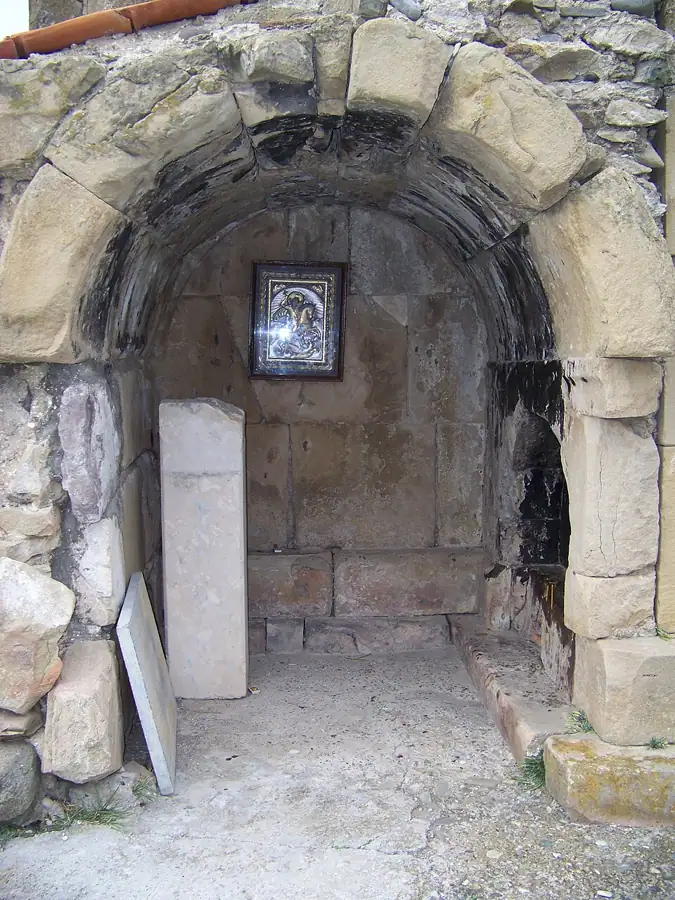
The walls also carry two messages in asomtavruli script. One, on the east façade, records a water channel built around 914, in the twentieth year of King Constantine III of Abkhazia, by Domnisos and Giorgi Tualaisdze. The other, on the south, names Merab Panaskerteli, the local lord who renewed the church in the late 15th or early 16th century; his mausoleum beside it shows him carved with his wife and son. The earthquake of 8 May 1940 damaged the church, and Georgian specialists repaired it in 1950–53.
From the top, the ruins of Samtsevrisi castle lie below you to the north-west, and on a clear day the Greater Caucasus lines the northern horizon. A lone pine keeps the church company. Come in the last hour of daylight, when the low sun warms the sandstone and the small building throws a long shadow.
Gallery
Practical advice
Forty minutes to an hour is enough. The path up the hill is bare earth and slick after rain, so wear closed shoes, and long trousers help against the scrub. The church may be locked, but here the exterior is the point — walk all the way round for the inscriptions and the carved mausoleum. There is no shade, café or toilet; bring water and eat in Kareli. Clear autumn and spring days give the best mountain views; summer haze often swallows them. Tsromi and Kintsvisi are close by.
How to get there from Tbilisi
Take the S1 (E60) motorway west from Tbilisi past Gori to the Kareli exit, about 99 km. Drive through Kareli and west along the old road (Sh29) for about 4 km, then turn off on the lane to the hill. Around 111 km and 1 hour 30 minutes in all. The last stretch is a mix of gravel and broken asphalt: in dry weather an economy car manages it, but after rain leave the car at the foot of the hill and walk up. Fuel in Gori or Kareli.
Click a marker for details. Coloured lines are ready-made road trips.
Nearby places
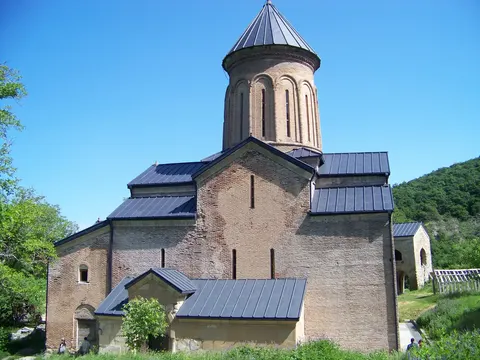
Kintsvisi Monastery
A red-brick Golden Age church in the forest near Kareli, where an angel in lapis-lazuli blue points to Christ's empty tomb.
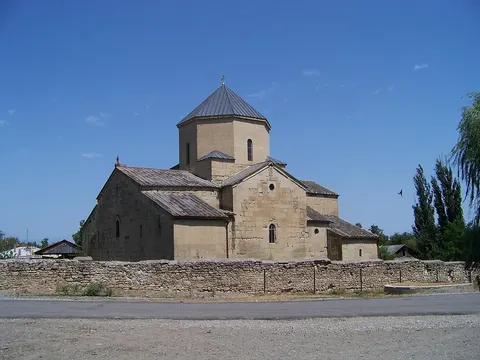
Tsromi Church
Built in 626–634 for Prince Stepanoz II, Tsromi was the first Georgian church to raise its dome on four free-standing piers.
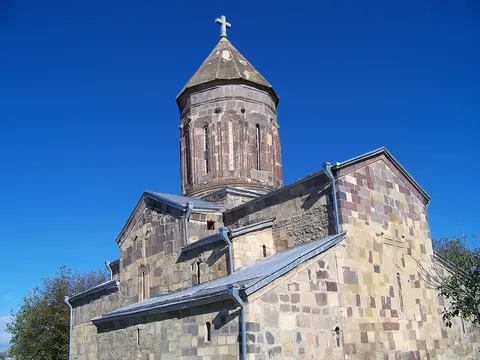
Ruisi Cathedral
It crowned a boy-king, hosted David the Builder's council, fell to Timur and rose again: Ruisi's patched, polychrome walls keep every entry.
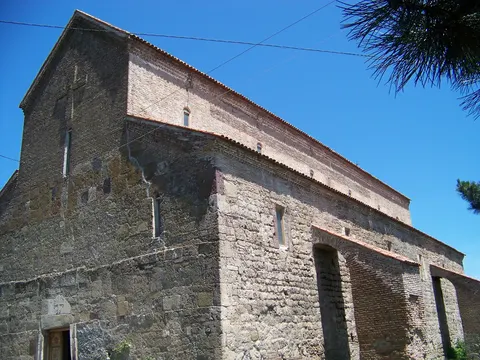
Urbnisi Cathedral
A long, low basilica of c. 500–600 in what was once ancient Iberia's second city, where David the Builder's church council met in 1103.
Best car for this trip
Mostly paved
Guides
- Driving in Georgia: What the Distances Actually Cost You Georgia is a small country with slow roads. Here is what 267 measured drives from Tbilisi say about how long y
Pickup locations
Car Rental in Tbilisi — 87 km (straight line)
Booking and enquiries
The easiest way to reach these places is by car — you pick the route and the stops.