
Bolnisi Sioni
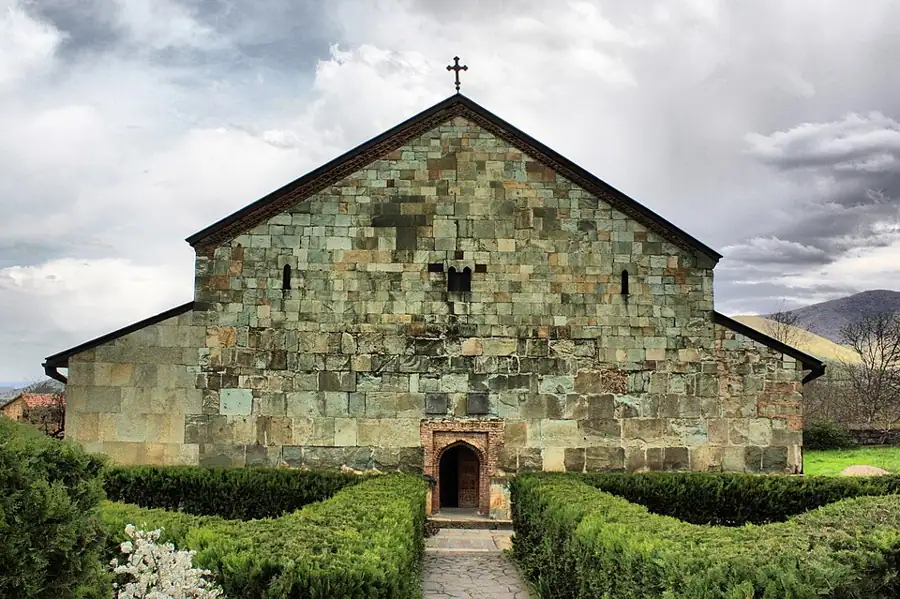
Georgia's oldest standing church, finished in 493–494 near Bolnisi, still carries the dated Georgian inscriptions its builders cut into the stone.
- Time needed
- 1 h
- From Tbilisi
- 70 km · 1:25
- Road
- Paved
- Car needed
- Economy class
- Season
- All year
- Entry
- free
Bolnisi Sioni is one of the rare buildings that tells you its own age: its builders carved the dates into the stone in the 490s.
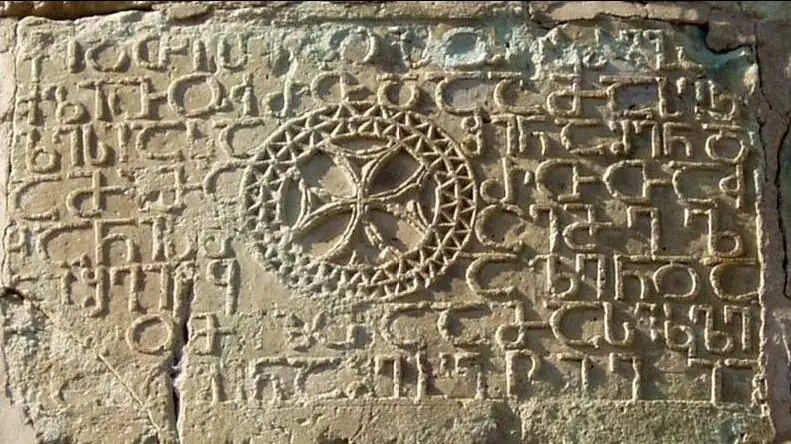
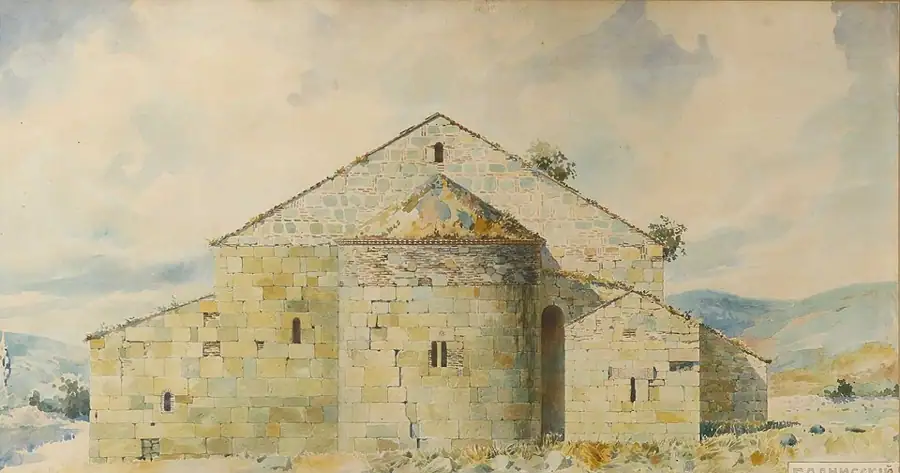
The basilica stands in the village of Kvemo Bolnisi, south of Bolnisi town. Begun in 478–479 and finished in 493–494, it is the oldest church still standing in Georgia. Its Asomtavruli inscriptions, among the earliest dated Georgian writing, record that work began in the twentieth year of King Peroz and ended fifteen years later, and they ask mercy for the builder, Bishop David. Peroz was the Sasanian shah of Persia; a Georgian church dated by an Iranian reign shows where this valley stood, between Byzantium and Iran. The stone in the wall today is a copy, set in place during the restoration of 1967–69.
Long, low and heavy, the church is built of tuff blocks shifting from pale green to straw-yellow and faint rose. The west door you walk through was cut only in the 17th century. Inside, look down at the column bases and up at the capitals: vine scrolls, arabesques and foliage of Sasanian ancestry, and beside them a bull's head, birds and beasts, the first relief sculpture in Georgian architecture, pagan images adopted by the new faith. Among the carved crosses is a flared one set in a circle, the Bolnisi cross; the four small crosses on today's national flag are officially described as being of the Bolnisi–Katskhuri type.
The valley has a younger story too. In 1818 ninety-five Swabian German families founded a colony nearby, Katharinenfeld. The Soviets renamed it Luxemburg in 1921, deported most of its Germans to Siberia and Kazakhstan in 1941 and called it Bolnisi from 1943. A room in the town museum remembers them.
Copy or not, these are the words the masons cut when the scaffolding came down fifteen centuries ago.
Practical advice
Bolnisi Sioni is a working church: women should cover their heads and wear a skirt, men long trousers. Carry a scarf of your own rather than relying on wraps at the door. Entry and parking are free. An hour is enough, but spend most of it close up: the carved bases and capitals reward patience, and a phone torch helps on a dull day. Tsughrughasheni, two kilometres further along the same road, is the natural second stop. Cafés, toilets and cash machines are in Bolnisi town, about eight kilometres north, and so is the Bolnisi Museum with its room on the German settlers.
How to get there from Tbilisi
Leave Tbilisi heading south on the S6, the Marneuli highway, and stay on it through Marneuli to Bolnisi. In the town centre turn south onto Sioni Street, the Sh154, and follow it for about eight kilometres to the village of Kvemo Bolnisi. That makes about 70 km and an hour and twenty-five minutes, all of it on asphalt, so an economy car is all you need. Fuel is easy to find in Marneuli and Bolnisi. Set your navigator to the church itself, not to Bolnisi town: the centre is eight kilometres short. At 620 metres the road stays open all winter.
Click a marker for details. Coloured lines are ready-made road trips.
Nearby places
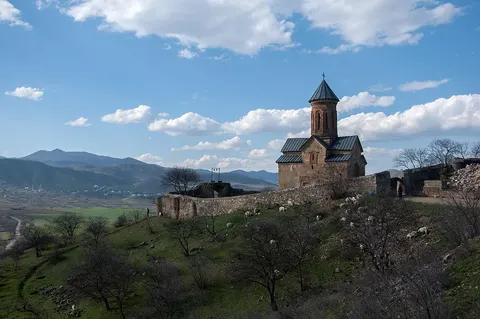
Tsughrughasheni Church
A small, soaring domed church of 1212–1222 near Bolnisi, built of golden, wine-red and blue stone and carved from drum to doorway.
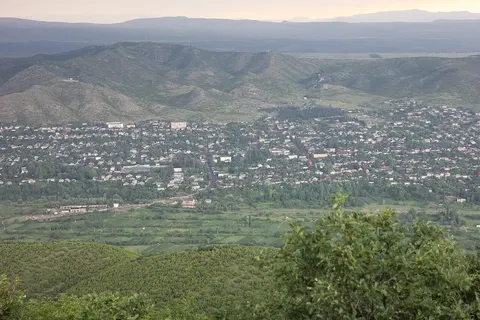
Bolnisi Town
Katharinenfeld, the Swabian colony of 1818: straight streets of German houses, Mill Street, a museum opened in 2020, and vineyards and copper all around.
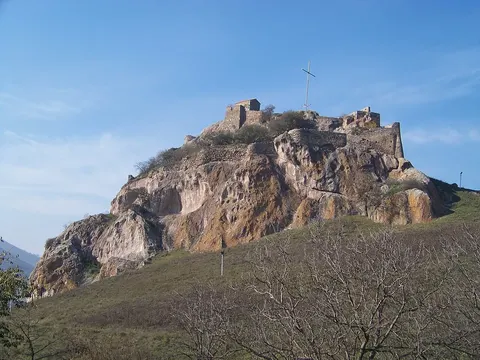
Kveshi Fortress
A crag-top fortress above the Mashavera near Bolnisi, entered through a tunnel in the rock and held by the Toreli, the Baratashvili and Daud Khan.
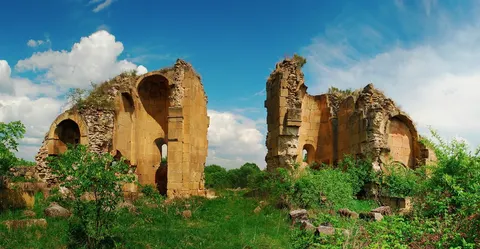
Samshvilde
A ruined city 2.5 km long on a triangular promontory where the Khrami and Chivchavi gorges meet: ancient Kartli's stronghold, sacked in 1440.
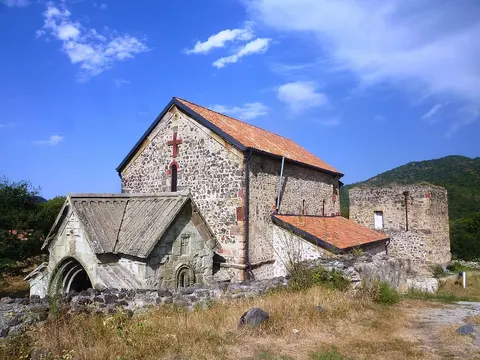
Dmanisi
A ruined medieval silk town above the Mashavera, and beneath its cellars 1.8-million-year-old skulls from one of humanity's earliest journeys out of Africa.
Part of these road trips
- Kvemo Kartli Archaeology Road 2 days · 285 km
Best car for this trip
Guides
- Driving in Georgia: What the Distances Actually Cost You Georgia is a small country with slow roads. Here is what 267 measured drives from Tbilisi say about how long y
Pickup locations
Car Rental in Tbilisi — 42 km (straight line)
Booking and enquiries
The easiest way to reach these places is by car — you pick the route and the stops.