
Shukhuti and Lelo Burti
Every Orthodox Easter the two halves of a Gurian village fight over a 16-kilo leather ball, and the winning ball ends up on a grave.
- Time needed
- 2 h
- From Tbilisi
- 278 km · 3:55
- Road
- Paved
- Car needed
- Economy class
- Season
- All year
- Entry
- free
On Orthodox Easter Sunday a priest drops a leather ball on the road through Shukhuti, and the village splits in two.
Upper Shukhuti heaves one way, Lower Shukhuti the other. No referee, no pitch, no clock. Any man who can stand and shove may play; the only aim is your own side's riverbank, a couple of hundred metres off. The ball weighs about sixteen kilograms — one pood, an old Russian measure of weight — and is packed hard with sand, earth and sawdust.
Making it is part of the rite. By custom a village shoemaker sews it. Neighbours gather round food and wine, drink toasts to the dead, and pour wine into the ball before the last stitches close. Once it was aguna: red wine with honey and pomegranate juice. The priest blesses it in church. Then the scrum rolls through gardens and over fences, for two hours or more.
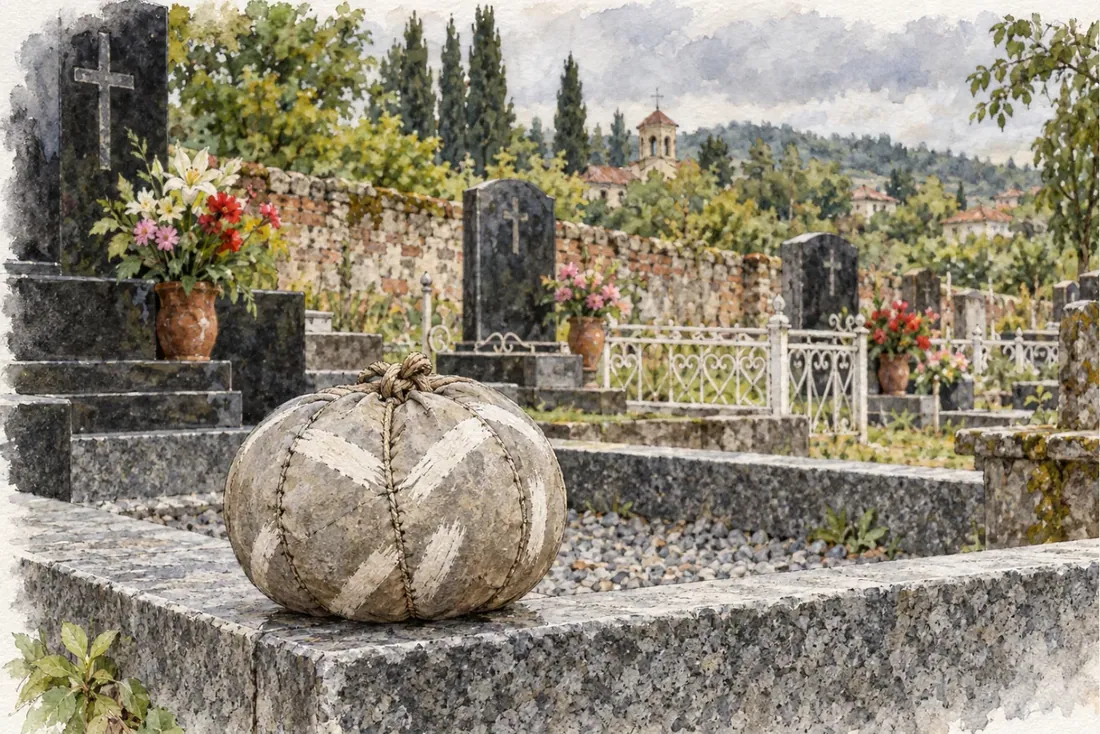
Each year's game is dedicated to a villager who has died. The winners carry the ball to that family's house, and later it is laid on the grave. In Shukhuti cemetery old balls still rest among the headstones: squat, grey, stitched in panels, a year painted on the leather.
The game is old. The heroes of Rustaveli's twelfth-century Knight in the Panther's Skin play it, and folk belief held that the winning village would reap the better harvest. Shukhuti ties its Easter game to a Crimean War battle fought nearby in 1855. It outlived Soviet disapproval: in the 1980s villagers dodged the police by moving it to 1 May, and the one year nobody touched the ball was 1989, after the 9 April killings in Tbilisi. In 2014 lelo burti was listed as intangible cultural heritage, and Georgia's rugby team is still called the Lelos.
The rest of the year the stream is just a stream.
Gallery

Practical advice
Orthodox Easter moves between April and early May, so check the date, arrive by late morning and ask locals when the ball goes in. This is full contact and the crowd moves fast: watch from a fence, a porch or a slope, and never stand between the scrum and the water. Wear shoes you can sacrifice. The road through the village becomes the playing field, so park on the edge and walk in. Lanchkhuti, three kilometres away, has shops and cafés. In the cemetery, look but do not touch the balls: each belongs to a family's dead.
How to get there from Tbilisi
From Tbilisi take the S1 (E60) west over the Rikoti Pass and past Kutaisi to Samtredia, then the S12 south-west to Lanchkhuti. Shukhuti lies about three kilometres from the town centre on the local road towards Japana (Sh208), to the east and south-east of Lanchkhuti. Do not follow older directions that send you west towards the coast. In all it is about 278 km and just under four hours, asphalt the whole way, and an economy car is fine. Fill up in Samtredia or Lanchkhuti. On Easter Sunday leave the car in Lanchkhuti or at the village edge and walk the last stretch.
Click a marker for details. Coloured lines are ready-made road trips.
Nearby places
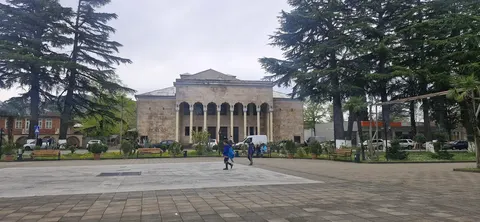
Lanchkhuti
Guria's northern gateway: birthplace of Noe Zhordania, a hotbed of the 1905 peasant revolt, and the last big stop before the sea.
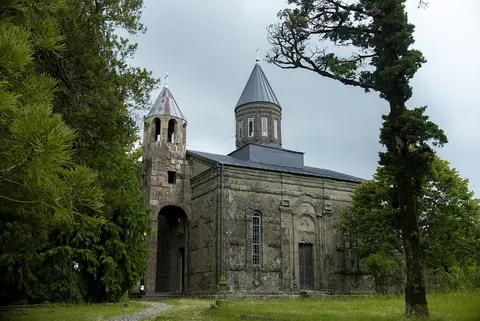
Sameba–Jikheti Convent
A convent on Nigoiti hill whose site, tradition says, was chosen by three doves, and where, the nuns say, the liturgy never stopped, even under Soviet rule.
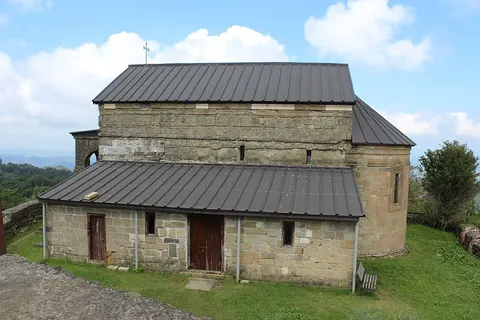
Jumati Monastery
A hilltop monastery of the Archangels above the Supsa valley. Its Byzantine enamels are in New York and St Petersburg; its horizon is still here.
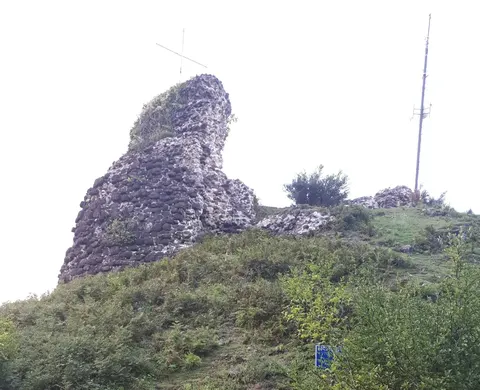
Telefisi Fortress (Tolebi)
A broken 6th-century wall on a steep hill above the Rioni plain — the Telephis where Byzantium and Persia fought for western Georgia.
Best car for this trip
Guides
- Driving in Georgia: What the Distances Actually Cost You Georgia is a small country with slow roads. Here is what 267 measured drives from Tbilisi say about how long y
Pickup locations
Car Rental at Kutaisi Airport — 36 km (straight line)