
Kaspi Church of St George
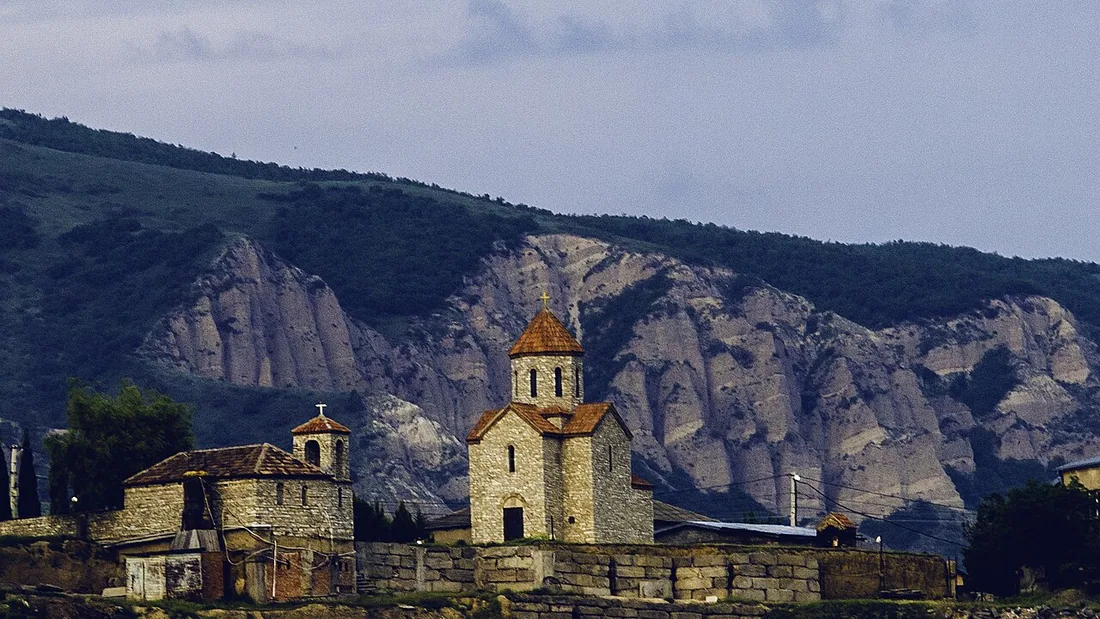
A working parish church in the centre of Kaspi, one of Georgia's oldest towns and once the seat of a 5th-century military governor.
- Time needed
- 0.5 h
- From Tbilisi
- 64 km · 0:55
- Road
- Paved
- Car needed
- Economy class
- Season
- All year
- Entry
- free
Kaspi's St George's is no museum piece but a working parish church on 26 May Street — where one of Georgia's oldest towns says its everyday prayers.
The town's roots go deep. Archaeologists have traced settlement here to the Bronze Age, and the 11th-century chronicler Leonti Mroveli credited its founding to Uplos, son of Mtskhetos — a legend, not a record. In the 5th century Kaspi was the seat of a spasalari, a military governor, and tradition says the young Vakhtang Gorgasali and his sister Mirandukht grew up here. Then, in the 730s, the Arab commander Marwan ibn Muhammad — "Murvan the Deaf" to Georgians — laid the town so thoroughly waste that urban life ended. A thousand years later the historian Vakhushti Bagrationi summed it up in one line: it "was a city until the Deaf One, and is now a large village." Kaspi regained city status only in 1959.
St George's belongs to the living town, not the ruined one. It is one of three active churches in the centre, alongside the cathedral of St Vakhtang Gorgasali and the church of St Theodore Tiron. We found no reliable record of when it was built, or by whom, and we will not invent one.
Come for a candle and a quiet minute, in a town that was a city until the Deaf One and took twelve centuries to become one again.
Practical advice
Entry is free. Cover shoulders and knees; women will want a headscarf. During a service keep your voice low and ask before taking photographs; Sunday-morning liturgy is the busiest time. Street parking is easy. Kaspi is a working town, so shops and cafés are in the centre and filling stations on the highway — a practical stop before you turn off towards the fortresses. Half an hour is plenty; pair it with Javakhaant Castle or Samtavisi Cathedral.
How to get there from Tbilisi
Head west from Tbilisi on the S1 (E60) highway past Mtskheta. It is paved the whole way: about 64 km and 55 minutes. Leave the highway at the Kaspi turn-off and follow the signs to the town centre; the church stands on 26 May Street, with ordinary street parking nearby. Filling stations are frequent along the highway. Any economy car will do — no climbs, no gravel. If you plan to continue to Javakhaant Castle, remember that its final stretch is a dirt track where extra ground clearance helps.
Click a marker for details. Coloured lines are ready-made road trips.
Nearby places
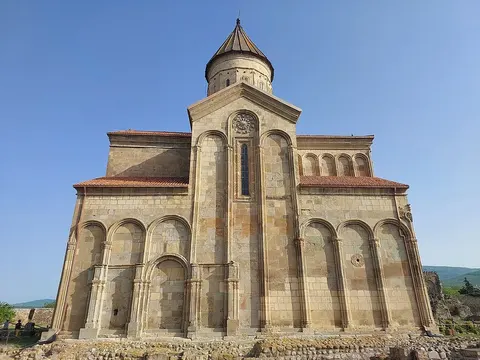
Samtavisi Cathedral
A cathedral of 1030 near Igoeti; its carved east front, a great cross over two stone diamonds, was copied by Georgian masons for generations.
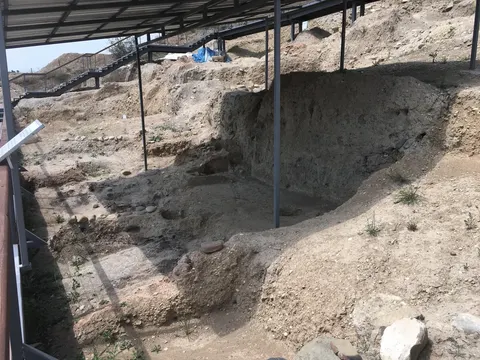
Grakliani Hill
A mound beside the Tbilisi–Gori motorway, found by road-builders in 2007, where a goddess's temple hid signs that may be the Caucasus's oldest script.
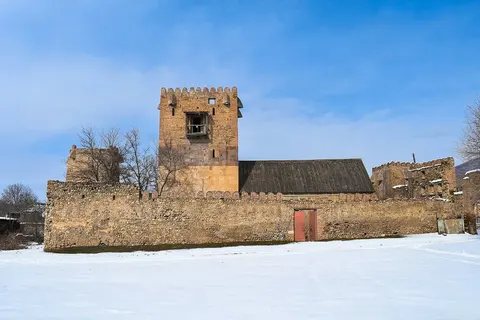
Amilakhvari Castle
Three 17th–18th-century castles of the Amilakhvari princes at Kvemo Chala: towers, a church with fresco fragments, an unfinished belfry and a domed bathhouse.
Skhvilo Fortress
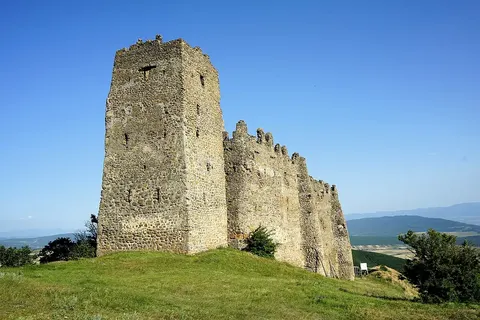
A 14th-century Amilakhvari stronghold on a high ridge above the Lekhura valley, whose only gate was set two metres off the ground.
Best car for this trip
Guides
- Driving in Georgia: What the Distances Actually Cost You Georgia is a small country with slow roads. Here is what 267 measured drives from Tbilisi say about how long y
Pickup locations
Car Rental in Tbilisi — 42 km (straight line)
Booking and enquiries
The easiest way to reach these places is by car — you pick the route and the stops.