
Beshtasheni
A Pontic Greek village on the Trialeti plateau, named after 'Five Stones' in Anatolia, beside a Bronze Age cyclopean settlement and cemetery.
- Time needed
- 1 h
- From Tbilisi
- 89 km · 1:40
- Road
- Paved
- Car needed
- Economy class
- Season
- All year
- Entry
- free
Beshtasheni means, roughly, "the village of Five Stones" — a name carried here from the mountains behind Trebizond.
The village tells its founding like this. The first settlers were Greek-speaking families from Argyroupolis (today's Gümüşhane), Maden and the villages around them, in the Ottoman province of Trebizond. They set out in late autumn, failed to reach their allotted land before winter and sat it out in Lower Tsintskaro, where their children picked up Turkish from the local Greeks. In the spring of 1830 they settled on the Tsalka plateau and, after a heated argument, named the village after Beshtash — the home of just one small group among them, and the Turkish form of the Greek Pende Petra, "Five Stones".
To Greeks fleeing Ottoman reprisals after the Russo-Turkish wars, Trialeti's high grassland recalled the Pontic Alps they had left. Their descendants are known as the Tsalka Urums. The 2014 census counted 335 people here; today the Greeks share the village with Georgian and Azerbaijani neighbours.
The stones are far older than the name. Beside the village lies the Beshtasheni cyclopean settlement, a fortified hilltop built of huge blocks in the manner of Bronze Age strongholds across the South Caucasus. About 300 metres away, north-west of the village along the road to Shua Kharaba, on the right bank of the Geriak-Chai, archaeologists Dimitri Narimanishvili and Revaz Varachkoria excavated a Late Bronze–Early Iron Age cemetery in 2015–2016.
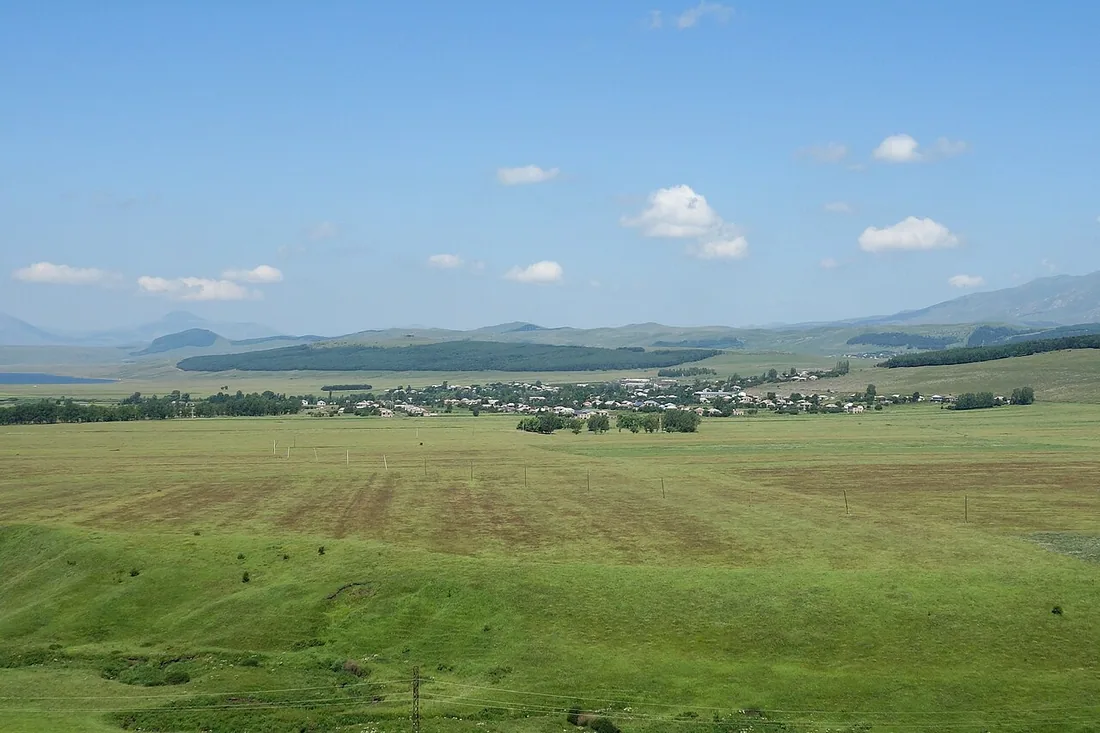
Do not expect a museum. This is a working village at 1,500 metres: wide pasture, low roofs among trees, a strip of water shining in the distance. The settlers brought their Five Stones with them; the plateau, it turned out, had been waiting with stones of its own.
Gallery
Practical advice
Beshtasheni is a living village, not a ticketed site, so do not count on signposts, information panels or visitor facilities. The excavated cemetery lies north-west of the village on the road to Shua Kharaba; ask locals politely before crossing fields, which are private pasture. At 1,500 metres evenings are cool even in August, and winters are long and snowy. Fuel, shops and a meal are in Tsalka. An hour is plenty; fill the day with the Tsalka Reservoir, Dashbashi Canyon and the Trialeti Lutheran church, all close by.
How to get there from Tbilisi
From Tbilisi climb out through Tskneti, take the Sh36 to Manglisi, then the Sh31 west across the Trialeti plateau towards Tsalka. A few kilometres short of Tsalka, turn off for Beshtasheni; the village is about 3 km from the main road. In all it is about 89 km and 1 hour 40 minutes, paved throughout, so an economy car is fine. In winter the Manglisi–Tsalka stretch can ice over, and winter tyres are essential. The nearest fuel is in Tsalka.
Click a marker for details. Coloured lines are ready-made road trips.
Nearby places
Bareti Lake
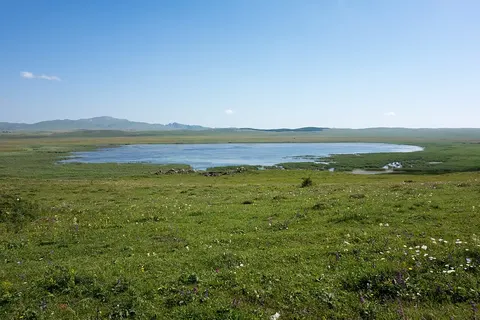
A shallow, rain-fed natural lake at 1,612 m on the open Trialeti plateau, full of waterfowl in season — the wild neighbour of the Tsalka Reservoir.
Tsalka Reservoir
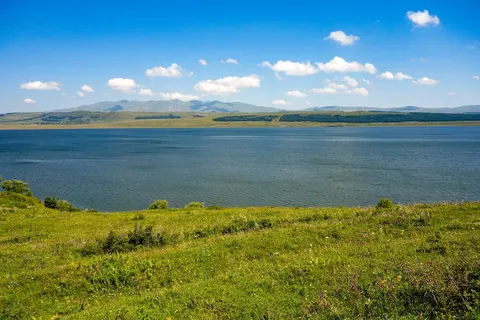
Georgia's largest reservoir by surface: 33.7 km² of cold, wind-whipped water at 1,506 m on the Tsalka plateau, where Bronze Age gold came out of the ground.
Dashbashi Canyon
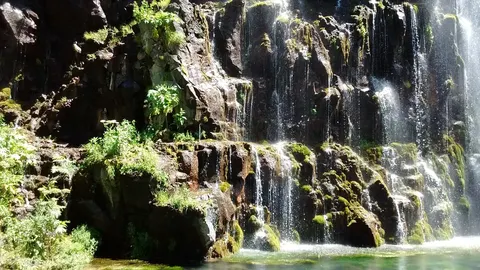
An eight-kilometre basalt gorge near Tsalka where springs burst from the rock as waterfalls, while the glass Diamond Bridge hangs overhead.
Trialeti Evangelical-Lutheran Church
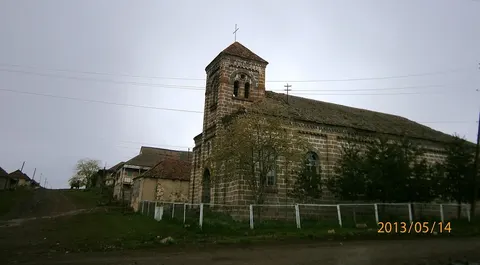
A stone church with a square bell tower, built by German colonists on the Trialeti plateau: a Soviet warehouse and cinema, now re-roofed and listed.
Best car for this trip
Guides
- Driving in Georgia: What the Distances Actually Cost You Georgia is a small country with slow roads. Here is what 267 measured drives from Tbilisi say about how long y
Pickup locations
Car Rental in Tbilisi — 57 km (straight line)
Booking and enquiries
The easiest way to reach these places is by car — you pick the route and the stops.