Timotesubani Monastery
A brick church of Queen Tamar's reign off the Borjomi-Bakuriani road, holding an unusually complete 13th-century fresco cycle.
- Time needed
- 1 h
- From Tbilisi
- 180 km · 2:45
- Road
- Mostly paved
- Car needed
- Economy class
- Season
- All year
- Entry
- free
Timotesubani has the best-preserved wall paintings in Samtskhe, and it is also, less obviously, a rarity in Georgian medieval architecture: the church is built not of stone but of rose-coloured brick.
The main church, dedicated to the Dormition of the Virgin, went up between 1195 and 1215, precisely in the reign of Queen Tamar. Its patron was Shalva Akhaltsikheli of the Toreli family, one of the commanders at the battle of Basiani. The plan is a domed cross-in-square with a tall, cleanly proportioned drum, and the brick surface takes on a warm, almost pink tone in sunlight.
The point of coming, though, is inside. The murals date from about 1205 to 1215 and form one of the most complete ensembles of Georgian golden-age monumental painting: deep blue grounds, large and unhurried figures, a full gospel cycle and portraits of the donors. A Georgian-Italian team conserved the paintings during the 2000s, and they can be read far better today than they could thirty years ago.
Brick was never a common building material in Georgia, and Timotesubani is the clearest surviving demonstration of what local masons could do with it. The walls are laid in even courses, and the decoration — blind arcading and simple geometric patterns — is achieved purely through the rhythm of the coursing, with no carved stone at all.
The yard also holds a small chapel, a later bell tower and the footings of monastic buildings. The monastery is active and monks live here, so quiet is simply expected rather than requested.
The setting helps. The church stands in the Gujareti valley at about a thousand metres, on the line where pine forest gives way to broadleaf woodland, and it is almost never crowded. Most of the traffic on the Bakuriani road drives straight past without knowing that two kilometres to the side stands one of the major surviving works of medieval Georgian painting.
Gallery
Practical advice
An hour is enough for the site, though the frescoes reward longer. The interior is lit only by daylight, so the best time is the middle of a clear day; on a cloudy evening the walls give up almost nothing. Photography may be restricted, so ask first. Women need a headscarf and a long skirt, men long trousers; wraps are usually left by the door. The toilet is basic and there is no food on site, the nearest cafes being in Tsagveri and Bakuriani.
How to get there from Tbilisi
From Tbilisi take the E60 to Khashuri, then head through Borjomi and follow the Bakuriani road. Beyond Tsagveri a sign marks the turn for Timotesubani, dropping left into the side valley. The total is 180 km, about two hours forty-five. The main road is asphalt; the final two kilometres are narrow and broken in places but perfectly passable in an ordinary car. There is a small clearing for parking at the monastery gate. Refuel in Borjomi.
Click a marker for details. Coloured lines are ready-made road trips.
Nearby places
 Ski area
Bakuriani
A ski resort at 1,700 metres in pine forest on the northern slope of the Trialeti range, above Borjomi.
 Spa resort
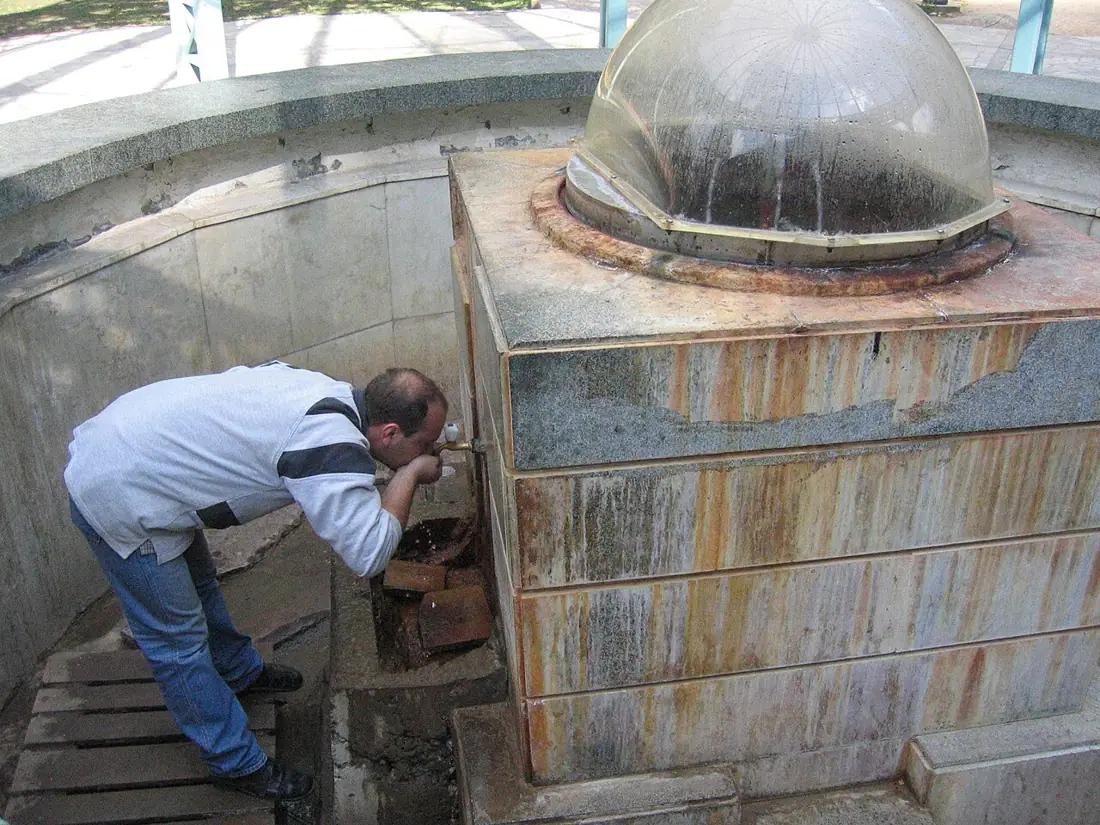
Borjomi Central Park and Mineral Springs
The historic spa park where you drink warm Borjomi water free, straight from the source.
 Museum
The Kukushka narrow-gauge railway and the Tsagveri bridge
A 37-kilometre narrow-gauge line opened in 1902 that takes two and a half hours to climb from Borjomi to Bakuriani.
 Monastery
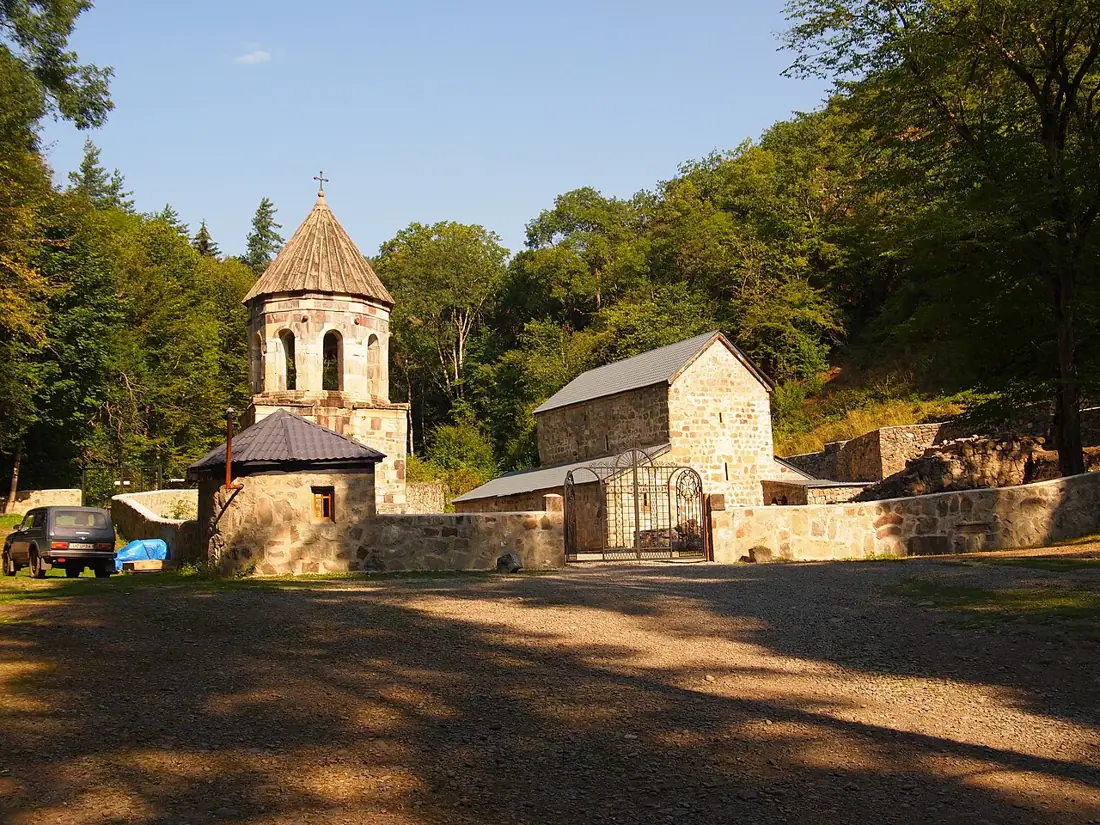
The Green Monastery (Chitakhevi St George)
A small monastery founded in the 9th century, hidden near Borjomi in a moss-covered forest gorge.
Booking and enquiries
This site is informational — there is no online payment. Call or email us to book.