Khobi Monastery
A 13th-century domeless church with carved facades, an open gallery and the burial vault of the Dadiani princes.
- Time needed
- 1 h
- From Tbilisi
- 308 km · 4:35
- Road
- Paved
- Car needed
- Economy class
- Season
- All year
- Entry
- free
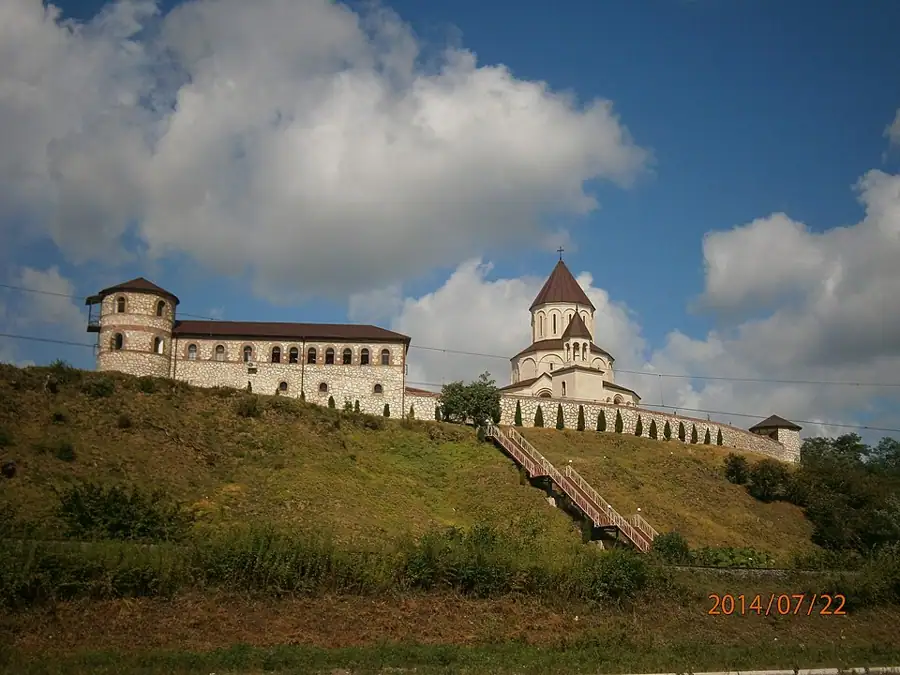
Khobi was the family abbey and burial ground of the Dadiani, and it remains one of the most refined medieval buildings in Mingrelia. It stands in the village of Nojikhevi, some three kilometres north of the town of Khobi.
The church of the Dormition of the Virgin is a domeless hall church with cross vaults. Its exact date is not recorded, but the art historian Vakhtang Beridze's dating to the second half of the thirteenth century is generally accepted. The monastery first appears in a Georgian document of 1212–1222, which names a bishop called Egnate.
An open gallery runs along the western and southern facades, and there are separate chapels in the north-western and south-western corners. The facades carry carved stonework — crosses, geometric bands and plant motifs — of a quality you rarely see on a provincial church. Vameq I Dadiani, who died in 1396, brought back fragments of Byzantine marble from a campaign against Zichia and had them built into the fabric; they are still visible.
Inside there are two layers of wall painting: thirteenth- and fourteenth-century work showing Palaiologan influence, and a seventeenth-century layer. Both are fragmentary, but in places faces and inscriptions read clearly.
Khobi was best known for its relics. Seventeenth-century travellers recorded the Robe of the Virgin here, together with relics of Saints Marina and Cyriacus. The robe was later moved to Zugdidi, where it is kept today, which is one good reason to see the two places on the same day.
The open gallery is a Mingrelian habit as much as an architectural device. In the lowland churches it gave covered space for burials and for people who could not go inside, and here it is where the Dadiani laid their dead; look down at the floor slabs as you pass; some inscriptions can still be read.
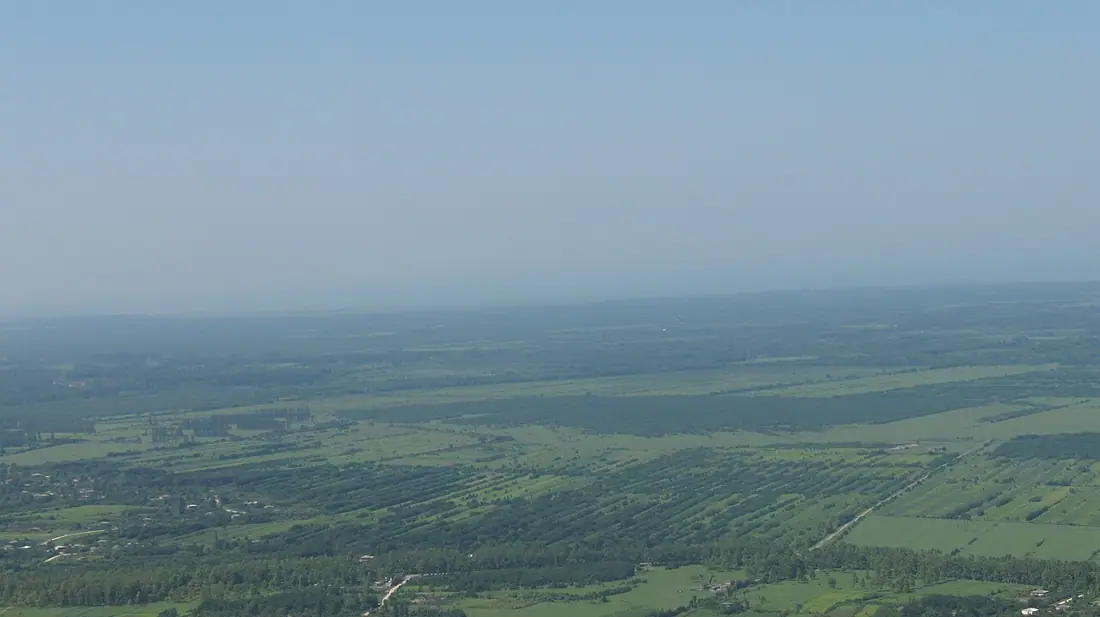
The land around is hazelnut. Khobi is one of the main nut-growing districts in Georgia, and in September the yards along the approach road are spread with drying kernels. The monastery has never stood in a wilderness, only in a quiet piece of farmed lowland worked for as long as the church has stood.
The monastery was closed in the Soviet period and now houses a community of nuns. In the yard stand a bell tower and stretches of the old enclosure wall, with a garden and tall trees around them. Visitors are few and the quiet is complete; this is a place where people find themselves walking slowly.
Gallery

Practical advice
An hour is enough. This is a working convent, so dress rules are taken seriously: headscarf and long skirt for women, long trousers for men. Keep your voice down, ask before photographing in the yard, and expect photography inside to be refused. There is a simple toilet in the grounds. Shops and cafés are in Khobi town, three kilometres away. In summer there is plenty of shade; in winter the church is cold and damp, so dress warmly, as the stone holds the chill all day.
How to get there from Tbilisi
From Tbilisi take the E60 to Senaki, continue towards Zugdidi and take the Khobi turning — about 308 km and a little over four and a half hours. From Khobi the monastery is another three kilometres north, towards the village of Nojikhevi. That last stretch is narrow asphalt with potholes, but a low car will manage it without trouble. Signposting is modest, so navigate by the bell tower. Parking at the gate is free. Refuel in Senaki or Zugdidi. An economy car is entirely sufficient.
Click a marker for details. Coloured lines are ready-made road trips.
Nearby places
 Archaeology
Nokalakevi (Archaeopolis)
A fortified city from the Lazic Wars above the Tekhuri river — walls, a secret tunnel and an active excavation.
 Monastery
Tsaishi Cathedral
A medieval bishop’s seat south-west of Zugdidi, with a fine bell tower and a church rebuilt almost out of recognition.
 Museum
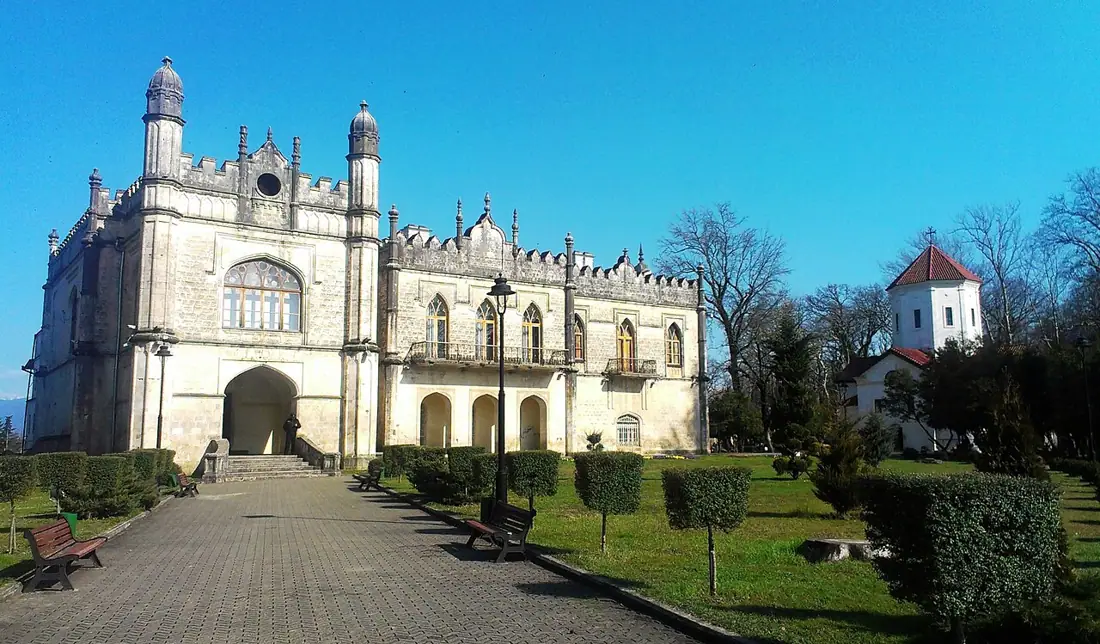
Dadiani Palace, Zugdidi
The residence of the princes of Mingrelia set in a botanical garden — Napoleon's death mask and the family collection.
 Town
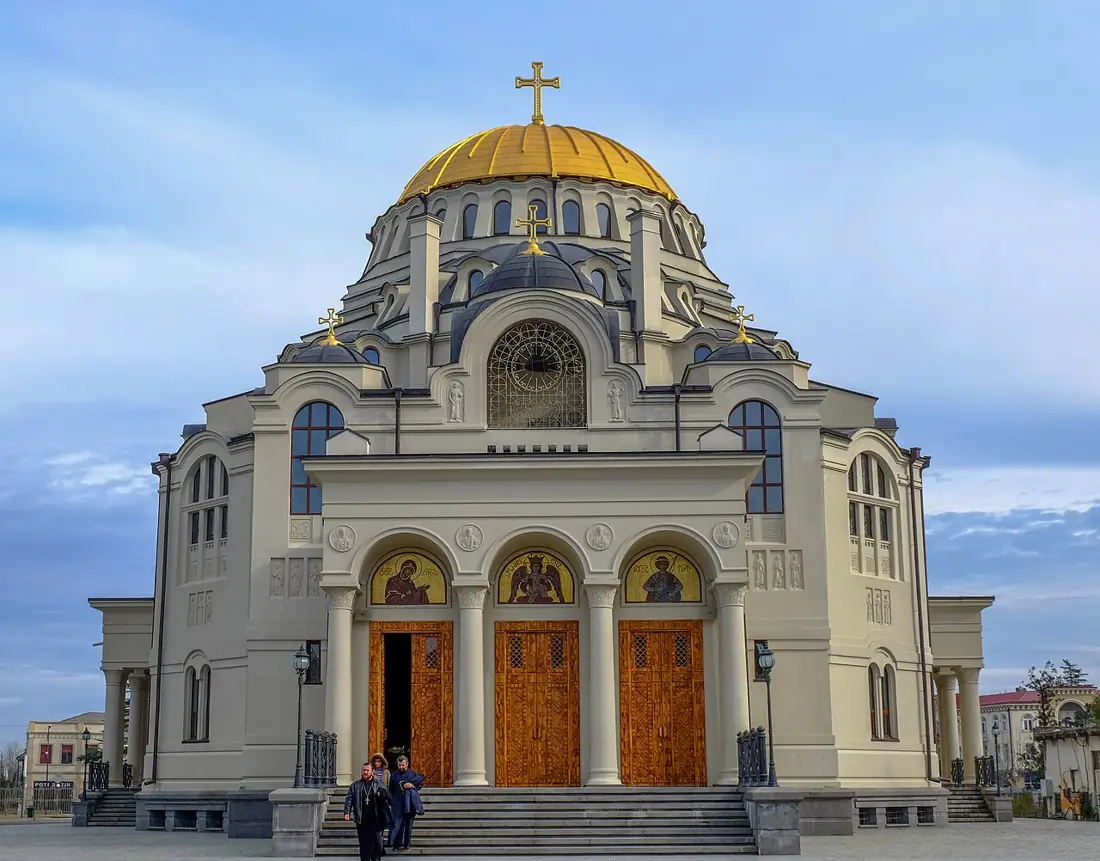
TownPoti
Georgia’s main sea port at the mouth of the Rioni, with an unusual circular street plan and a cathedral modelled on Hagia Sophia.
Booking and enquiries
This site is informational — there is no online payment. Call or email us to book.