Chiatura Cable Cars
A manganese mining town wedged in the Kvirila gorge, where the public transport system runs vertically.
- Time needed
- 3 h
- From Tbilisi
- 215 km · 3:10
- Road
- Paved
- Car needed
- Economy class
- Season
- All year
- Entry
- free
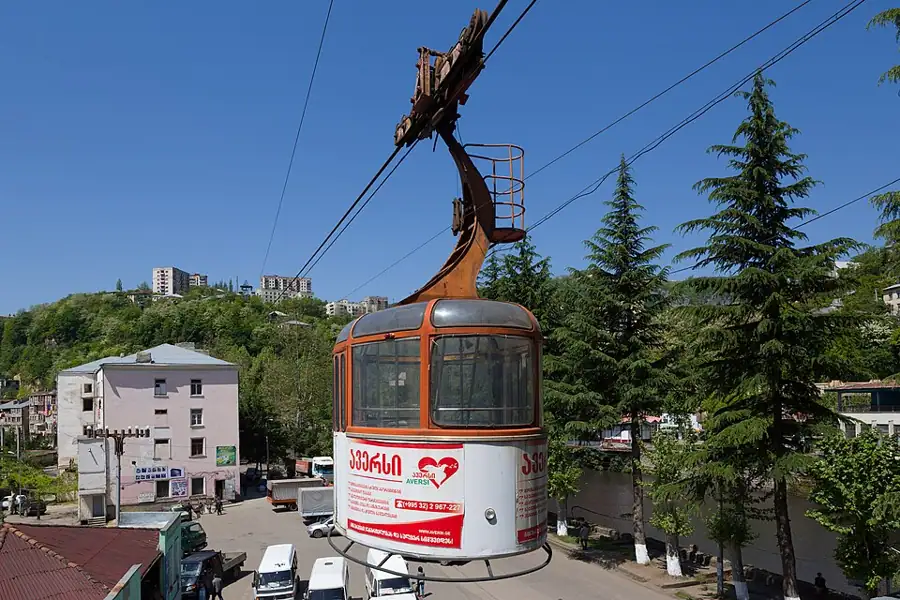
Chiatura is the only town in Georgia where public transport goes up and down rather than along. The town sits in a canyon of the Kvirila, the walls rise a hundred to two hundred metres, and the residential districts are on the plateaus above. Walking up takes half an hour; the cable car takes two minutes.
It all began with manganese. In 1879 the poet Akaki Tsereteli publicised the industrial value of the local ore, and within twenty-five years Chiatura was producing roughly 60 per cent of the world's manganese. The mines still work, and the gorge walls carry conveyors, ore bunkers and grey spoil heaps.
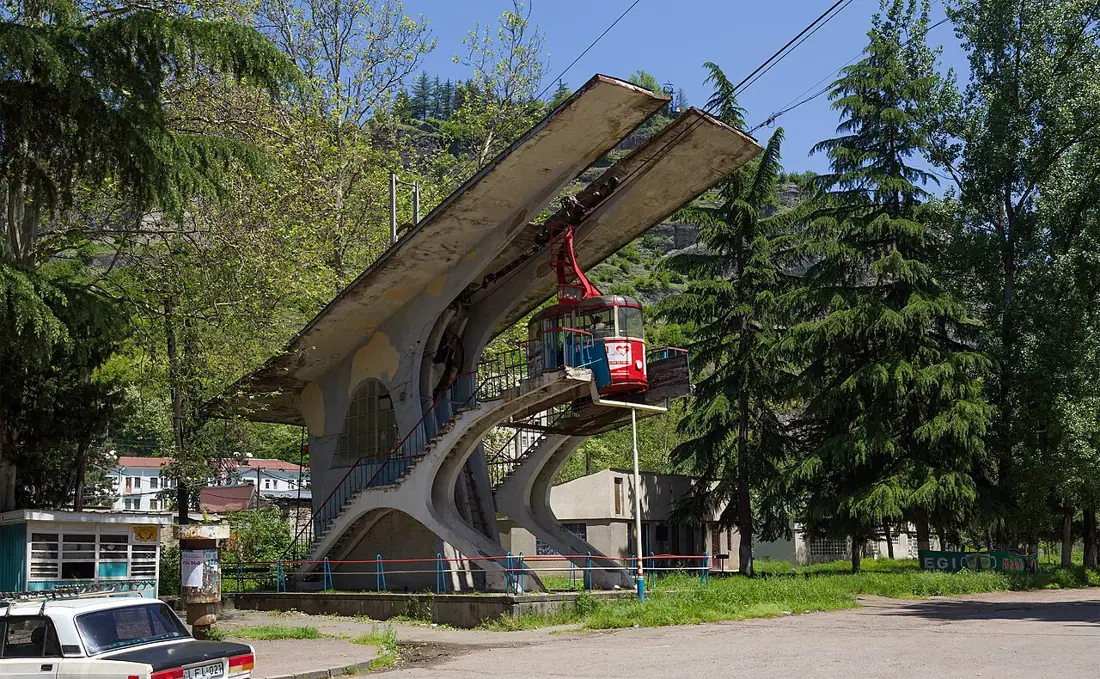
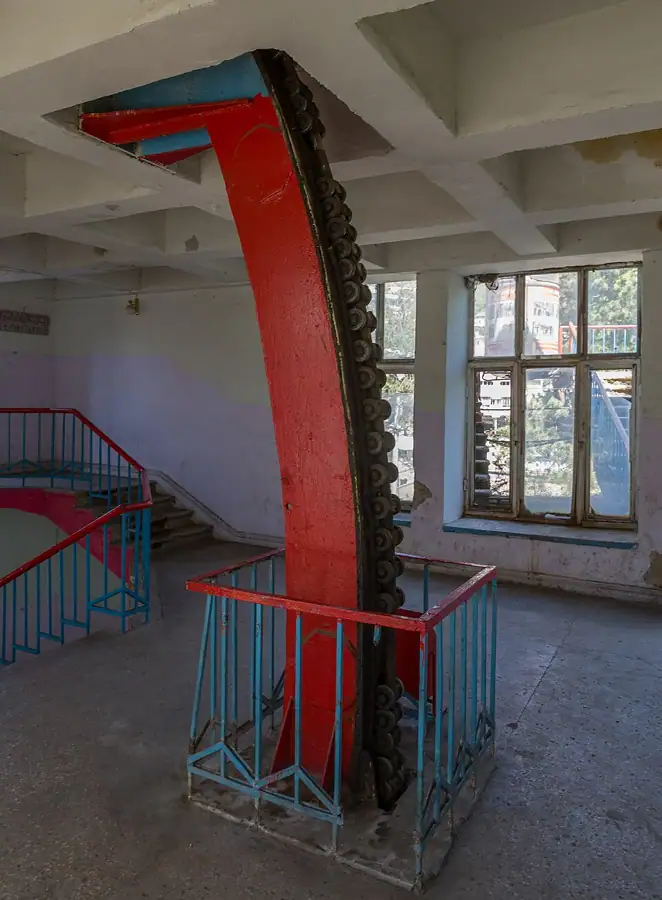
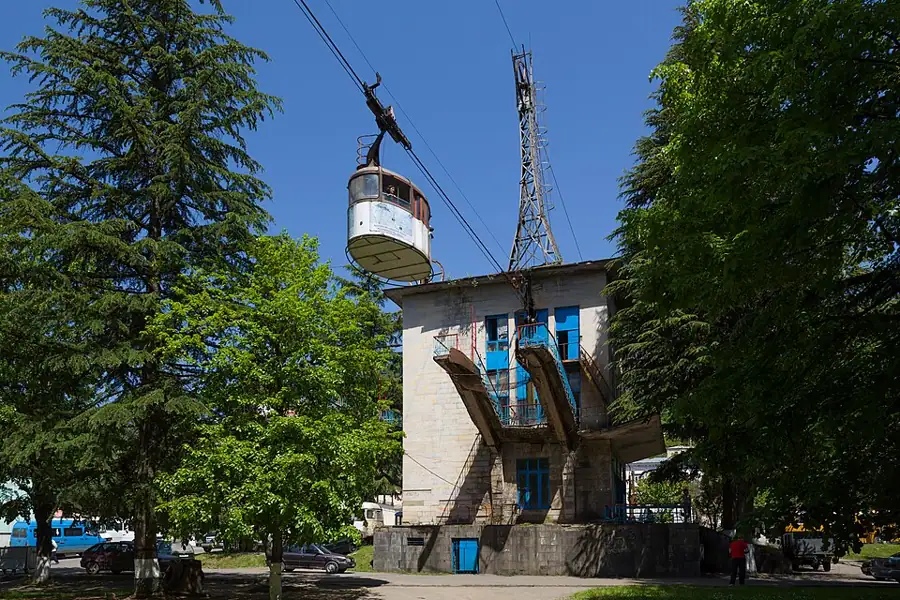
The ropeway network opened in 1954, because there was no other practical way to get miners to the workings. It grew to seventeen lines and ran for nearly fifty years on original equipment. From 2017 the state began replacing it: a central four-line hub entered service in September 2021, a further line was added in early 2025, and some routes remain closed. The old square cabins no longer run, and several historic stations are marked for preservation.
What you actually see today:
-
the new cabins in service, free to ride, from the centre up to the upper districts
-
abandoned stations — concrete towers, rusted winding gear, broken glass
-
a 1950s Soviet town centre on the canyon floor: theatre, park, stadium
Chiatura is not a pretty town and does not pretend to be. It is worth the detour as an industrial landscape, and as a place where a Soviet engineering answer to an awkward geography is still doing a daily job.
For a resident this is not a ride but a commute. The cabins were free from the start and are still free, and people use them to reach the shops, the school and the cemetery. The old system is still called Stalin's ropeway locally, because it was conceived in the last years of his rule — and until 2021 you could genuinely travel in a cabin riveted together in the 1950s.
Gallery
Practical advice
Three hours covers the town and a few rides. Travel is free, the cabins are small, and at shift times they fill with commuters — midday is easier for photographs. Do not climb into the abandoned stations: floors have collapsed and cables are under tension. Cafes and shops are around the central square, with toilets by the theatre. Because the gorge is deep, winter sun arrives late and the town stays damp all day. Mine sites themselves are closed to visitors.
How to get there from Tbilisi
Follow the E60 west from Tbilisi to Zestaponi, about 180 km, then turn north up the Kvirila valley towards Chiatura, a further 35 km. Total 215 km, roughly three hours ten. The whole route is asphalt; after Zestaponi it narrows, with many bends and heavy lorry traffic. Refuel in Zestaponi. In the centre you can park free beside the main square. Katskhi Pillar stands on the same road about 10 km before town, so the two combine easily. An economy car is enough.
Click a marker for details. Coloured lines are ready-made road trips.
Nearby places
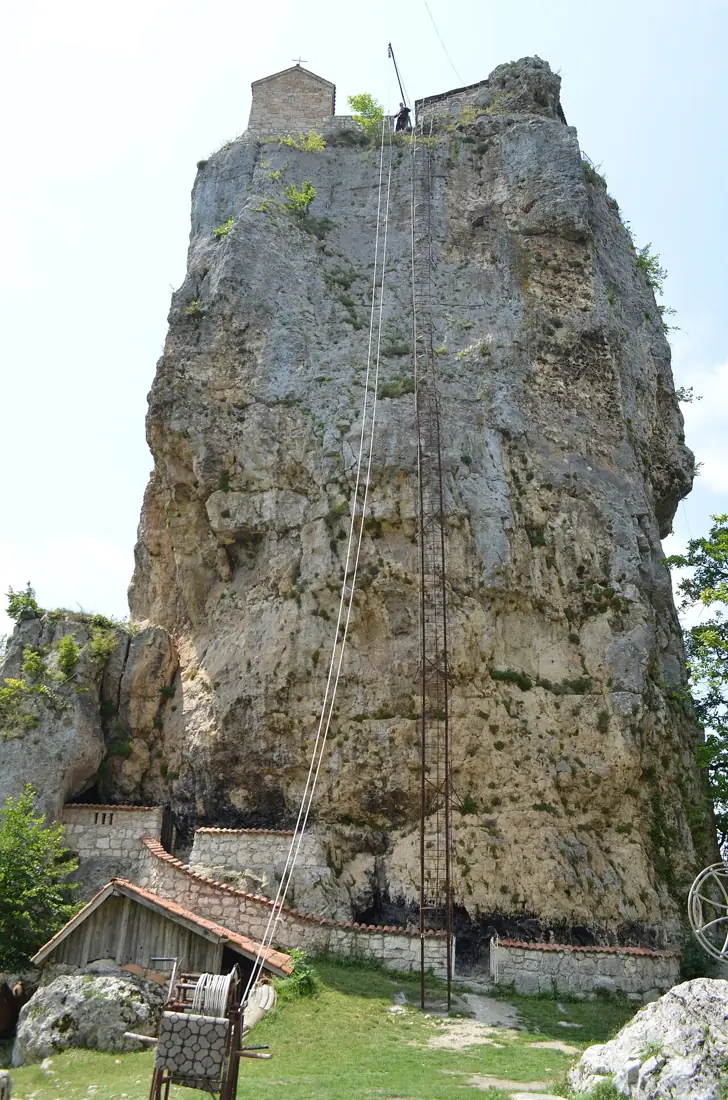 Monastery
Katskhi Pillar
A forty-metre limestone monolith with a church on top — visitors cannot climb it.
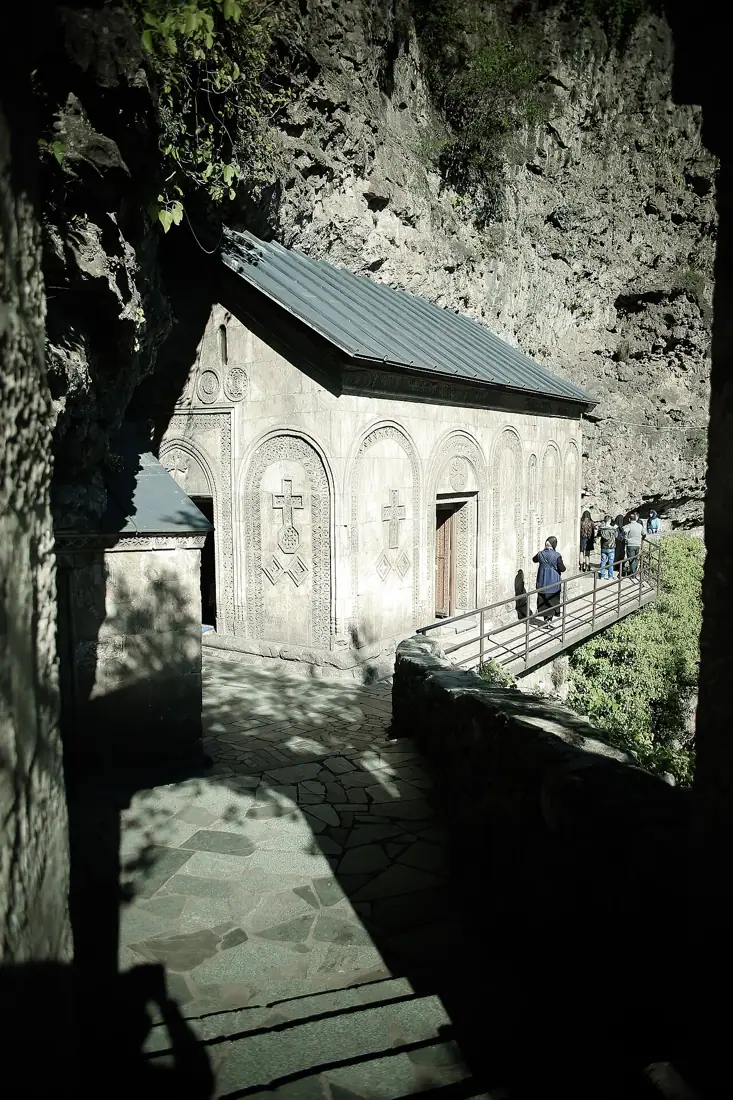 Monastery
Mgvimevi Monastery
A 13th-century monastery tucked under a cliff at the eastern edge of Chiatura, at the end of a narrow ledge path.
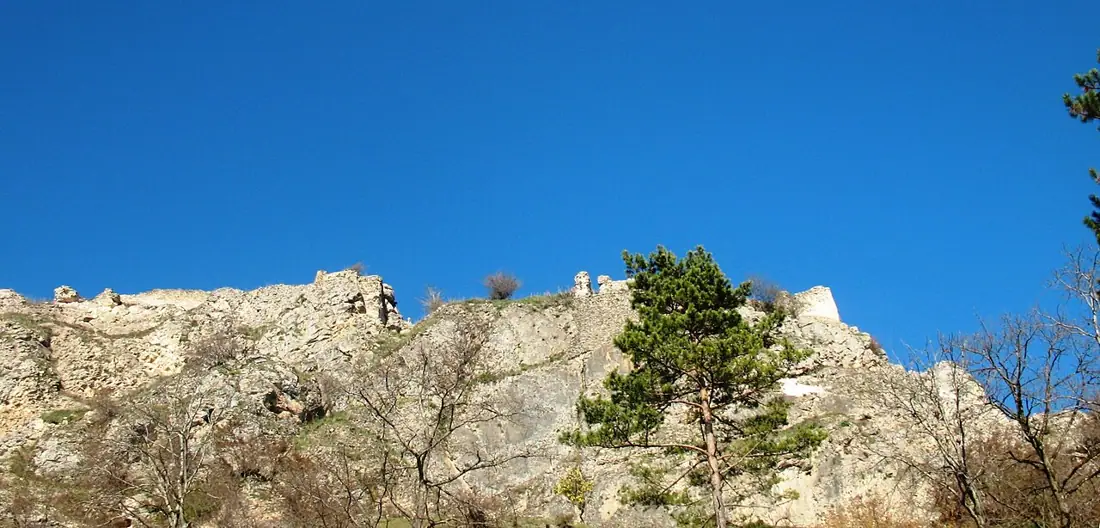 Fortress
Modinakhe Fortress
The Tsereteli family's fortress above Sachkhere, whose name means, literally, "come and see".