
Art Palace (Museum of Cultural History)
A Gothic-Moorish palace built for a scandalous love affair, now home to 300,000 objects from Georgian theatre, film, opera and dance.
- Time needed
- 1.5 h
- From Tbilisi
- 5 km · 0:15
- Road
- Paved
- Car needed
- Economy class
- Season
- All year
- Entry
- 12 ₾
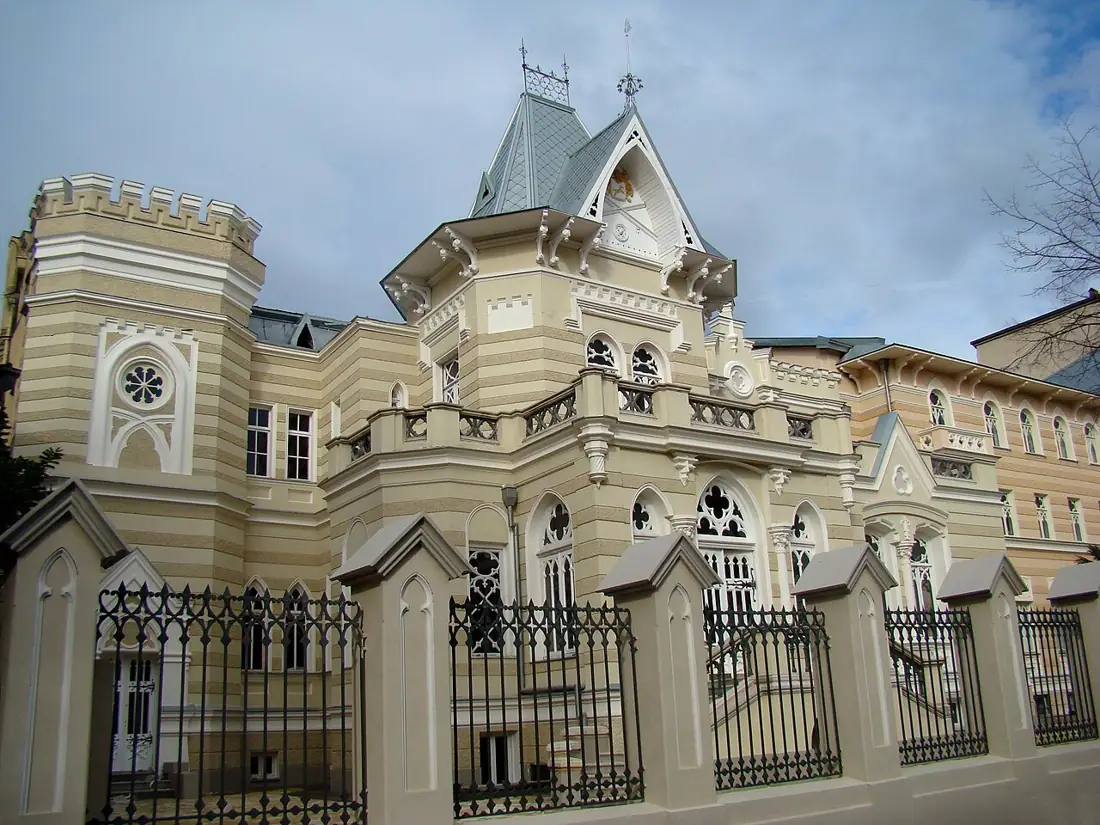
In 1882, in Kutaisi, a relative of the Romanovs fell in love with a married Georgian noblewoman, and this turreted palace in Chughureti is what the scandal built.
He was Duke Constantine Petrovich of Oldenburg (1850–1906), of the Russian branch of the House of Oldenburg; she was Agrippina Japaridze, wife of Prince Tariel Dadiani. The duke declared his love, the two left Kutaisi together and settled in Tiflis, and Agrippina paid a real price: her four children by Dadiani remained with his family. For her the duke commissioned a residence from the architect Paul Stern, a piece of historicism where Gothic meets Islamic architecture: pointed windows, Moorish arches, a turret and an ironwork fence. The Polish architect Aleksander Rogojski designed part of the interiors.
In 1927 David Arsenishvili (1905–1963), later the first director of the Andrei Rublev Museum in Moscow, moved his Theatre Museum into the house at just twenty-one. The collection has since passed 300,000 objects on Georgian theatre, cinema, circus, folklore, opera and ballet, and since 2020 the museum has been called the Art Palace of Georgia. Three things to seek out:
- set and costume designs, some 10,000 works by more than 300 Georgian artists, Petre Otskheli among them
- a theatrical mask from antiquity, excavated at Vani
- Qajar-era Persian miniatures, and works by Léon Bakst, Konstantin Korovin and Alexandre Benois
A love affair that scandalised Kutaisi ended up sheltering the memory of the whole Georgian stage. It is hard to imagine a more theatrical afterlife for a house.
Practical advice
Open Tuesday to Sunday, 10:30–17:30; closed on Mondays. Entry is 12 GEL. Ask whether a guide is available: the best stories, about the duke, Agrippina and the rooms themselves, are not written on the labels. Temporary exhibitions change often, so check artpalace.ge before you go. The garden is shaded and quiet, and crowds are rare. The State Silk Museum is under a kilometre away and makes a natural pairing, but check its hours before you go: they differ from the Art Palace's.
How to get there from Tbilisi
The palace stands at 6 Ia Kargareteli Street in Chughureti, on the left bank of the Mtkvari. From Freedom Square cross the river by the Dry Bridge or the Saarbrücken Bridge, climb to Marjanishvili Square and carry on north through Chughureti to Kargareteli Street: about 5 km by road, 10–15 minutes without traffic. Park in the paid zone along Kargareteli and the neighbouring streets (Tbilisi Parking app); spaces near Marjanishvili Square are harder to find. An economy car is all you need. Without one, Marjanishvili metro station is about a ten-minute walk away.
Click a marker for details. Coloured lines are ready-made road trips.
Nearby places
Fabrika and the Marjanishvili District
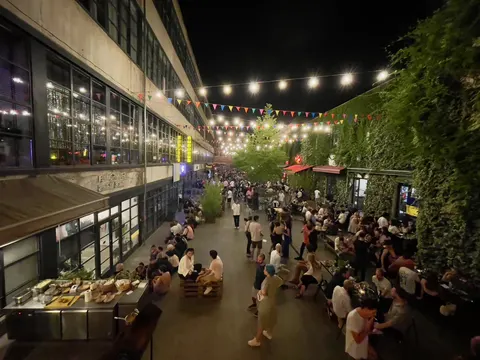
A Soviet sewing factory turned into a courtyard of bars, studios and a hostel, set in Chughureti — an old left-bank district not yet polished into a set.
Kote Marjanishvili Theatre
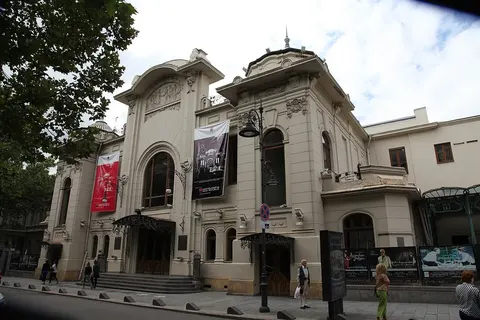
An Art Nouveau people's house on Marjanishvili Street, home since 1930 to the company Kote Marjanishvili founded — Tbilisi's 'social theatre'.
Dry Bridge Market
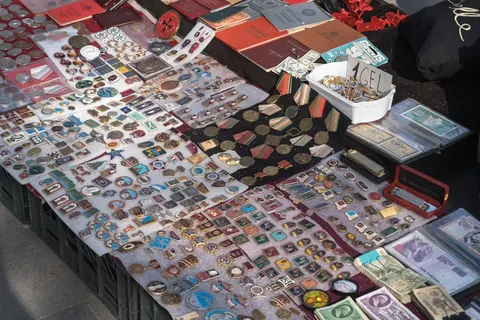
A stone bridge left high and dry in the 1930s, now spread with Soviet medals, cameras, enamel, samovars and the leftovers of family life.
Best car for this trip
Guides
- Driving in Georgia: What the Distances Actually Cost You Georgia is a small country with slow roads. Here is what 267 measured drives from Tbilisi say about how long y
Pickup locations
Car Rental in Tbilisi — 3 km (straight line)