Shio-Mgvime Monastery
A 6th-century monastery in a dry limestone canyon, built around the cave where the Assyrian father Shio lived and died.
- Time needed
- 1.5 h
- From Tbilisi
- 35 km · 0:50
- Road
- Mostly paved
- Car needed
- Economy class
- Season
- All year
- Entry
- free
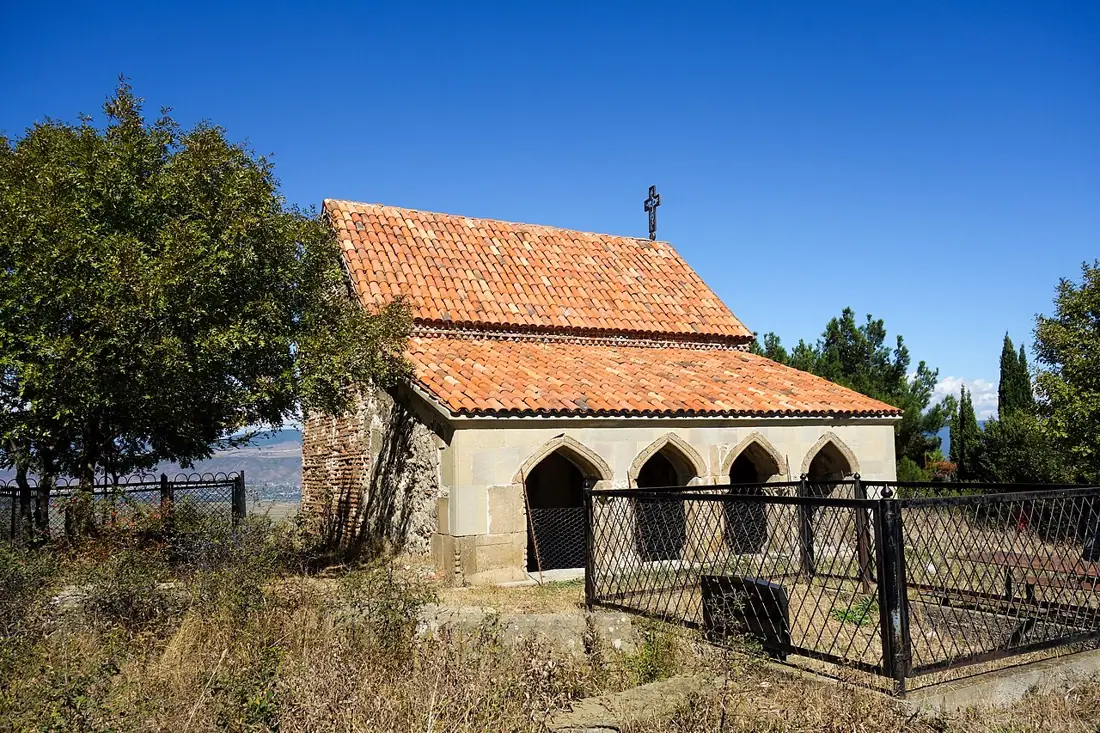
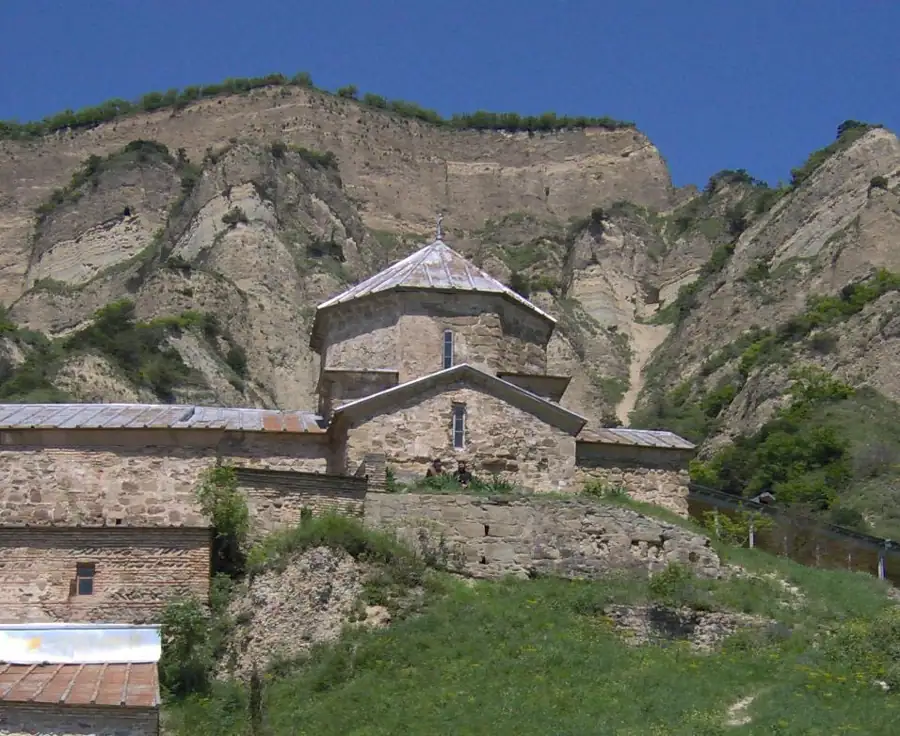
Shio-Mgvime sits in a dry limestone canyon that looks nothing like the green valley you drove out of. Nine kilometres of narrow road from Mtskheta bring you into a pale, almost treeless gorge; the monastery appears below you, low buildings on a shelf of rock, with caves pocking the cliff above.
The founder was Shio, one of the Thirteen Assyrian Fathers who came to Kartli in the 6th century to strengthen a young church. He chose the hardest option available: he lived in a deep cave, was said to be fed by a dove, and finally had himself sealed into a pit, where he died around 560. His tomb is in a small dark chamber below the main church, reached by a flight of stairs, and a candle is nearly always burning there.
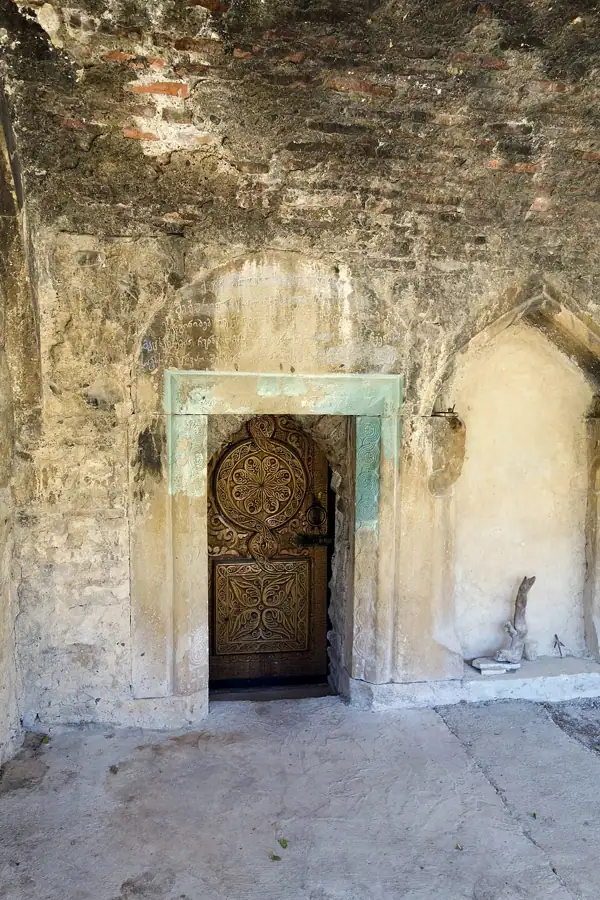
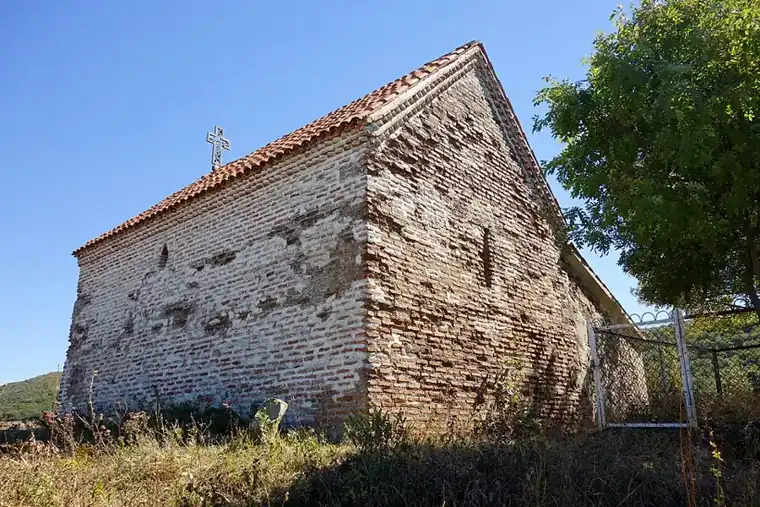
The Church of St John the Baptist, built between about 560 and 580, is the oldest surviving structure and one of the earliest domed churches in Georgia — squat, cruciform, austere, cut partly into the rock. The larger Church of the Virgin above it was a domed 12th-century foundation of David the Builder, ruined more than once and rebuilt in the 17th century as a plain barrel-vaulted hall, so the outside looks far older than the interior.
Shah Abbas's troops sacked the site in 1614, Persian raiders again in the 1720s, and it was revived in the 19th century. Besides the churches there survive:
-
a 12th-century stone water conduit several kilometres long, built on the orders of Bishop Anton of Chkondidi to bring spring water down to the monastery
-
the ruins of the refectory and the monks' cells
-
dozens of hermits' caves in the cliffs, a few reachable by a rough path, most not
Come in late afternoon. The rock turns orange, the canyon fills with shadow, and the place stops looking like a car park with a church at the end of it.
Gallery
Practical advice
An hour and a half covers it, including the walk down to Shio's tomb and back. The stairs to the tomb are steep, worn and badly lit, so a phone torch helps. This is an active male monastery: long trousers for men, a skirt or wrap and a headscarf for women, all supplied at the gate. There is a toilet by the car park and usually a stall selling candles and honey, but no café — the nearest food is back in Mtskheta. Do not attempt the final kilometres in snow or after heavy rain in a low car.
How to get there from Tbilisi
From Tbilisi run up to Mtskheta on the E60, about 20 km, then take the small road that leaves the town westwards past the cemetery and climbs into the gorge. That is another 12 km, 35 km and roughly 50 minutes in all. The surface is asphalt but old, narrow and patched, with unfenced drops in places and almost nowhere to pass a bus. An economy car is enough in dry conditions; after heavy rain or snow the last stretch is better left to an SUV. Fuel and shops are in Mtskheta — there is nothing beyond it.
Click a marker for details. Coloured lines are ready-made road trips.
Nearby places
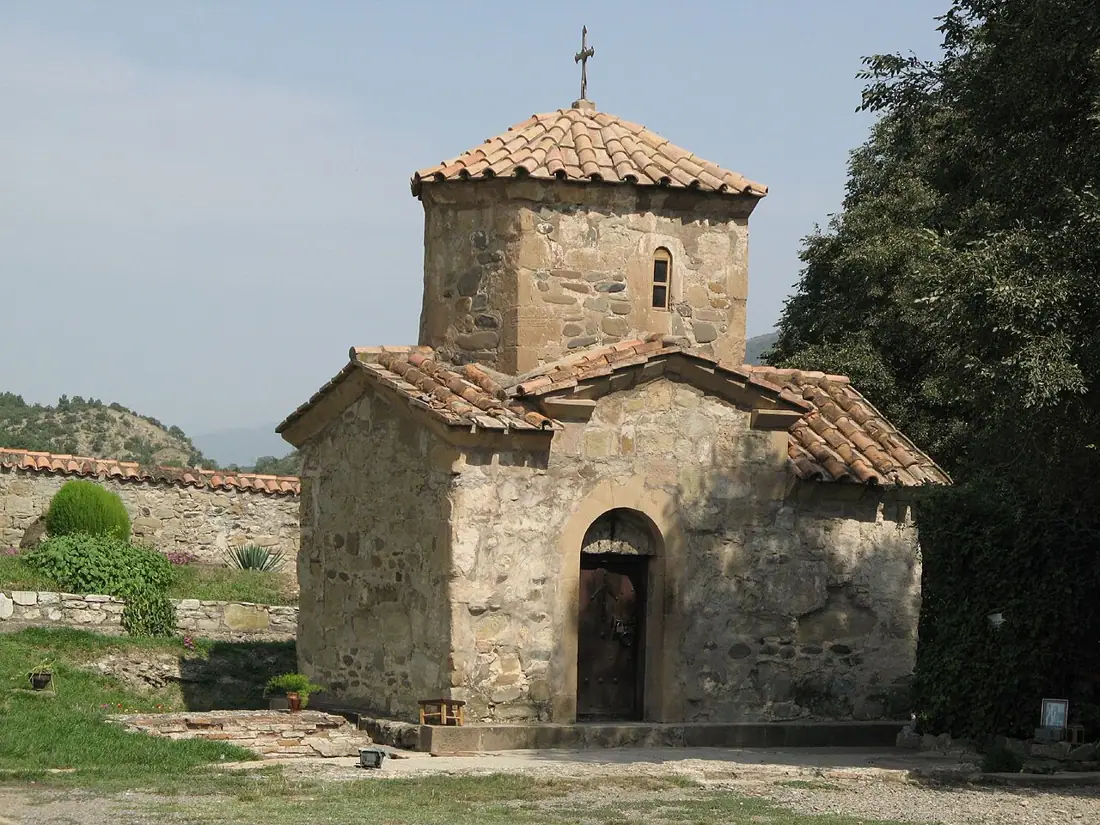 Monastery
Svetitskhoveli Cathedral
The 11th-century cathedral of Mtskheta, said to hold the robe of Christ — the mother church of Georgian Orthodoxy.
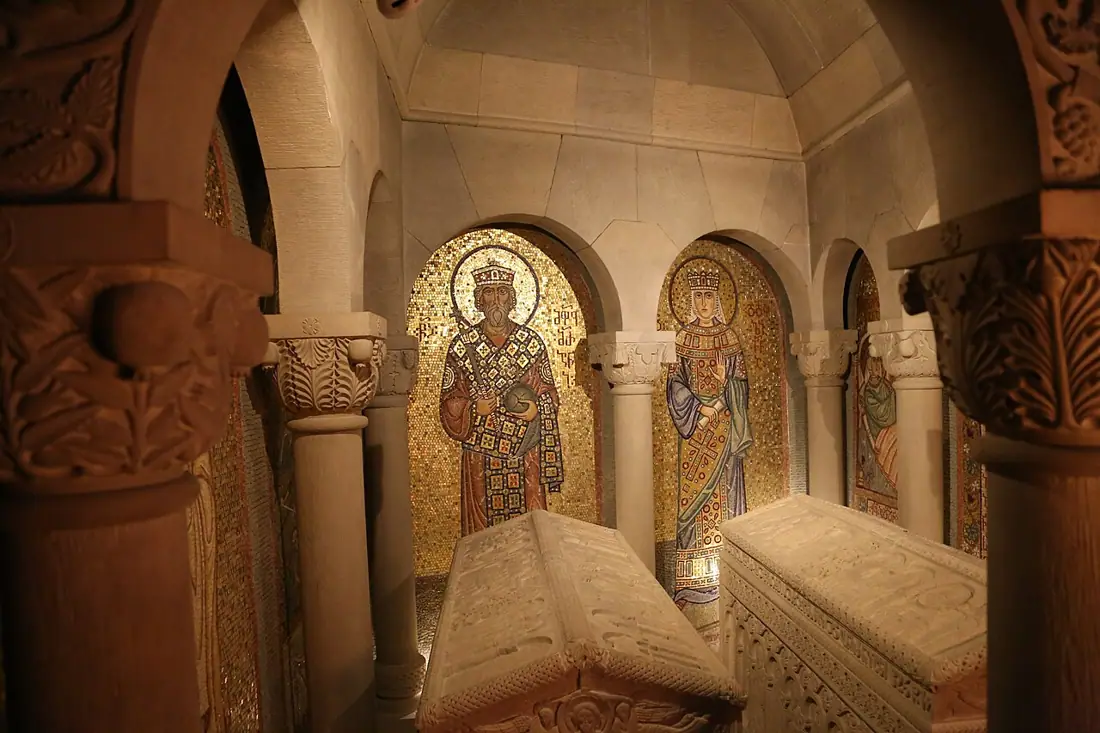 Monastery
Samtavro Monastery
The quieter half of Mtskheta's UNESCO ensemble — a working nunnery holding the graves of Georgia's first Christian king and queen.
 Winery
Château Mukhrani
The 19th-century palace and working cellar of the Bagration-Mukhrani princes on the Mukhrani plain west of Mtskheta.
Booking and enquiries
This site is informational — there is no online payment. Call or email us to book.