Kvetera Fortress and Church
The remains of a fortified town on a wooded hill near Akhmeta, with a tiny 10th-century church under a blue tiled roof.
- Time needed
- 1 h
- From Tbilisi
- 120 km · 2:20
- Road
- Mostly paved
- Car needed
- Crossover / SUV
- Season
- All year
- Entry
- free
Kvetera is an odd pairing: an abandoned fortified town and a miniature, almost perfect church. It stands a few kilometres from Akhmeta on a free-standing wooded hill, off the road that runs up towards the Pankisi valley.
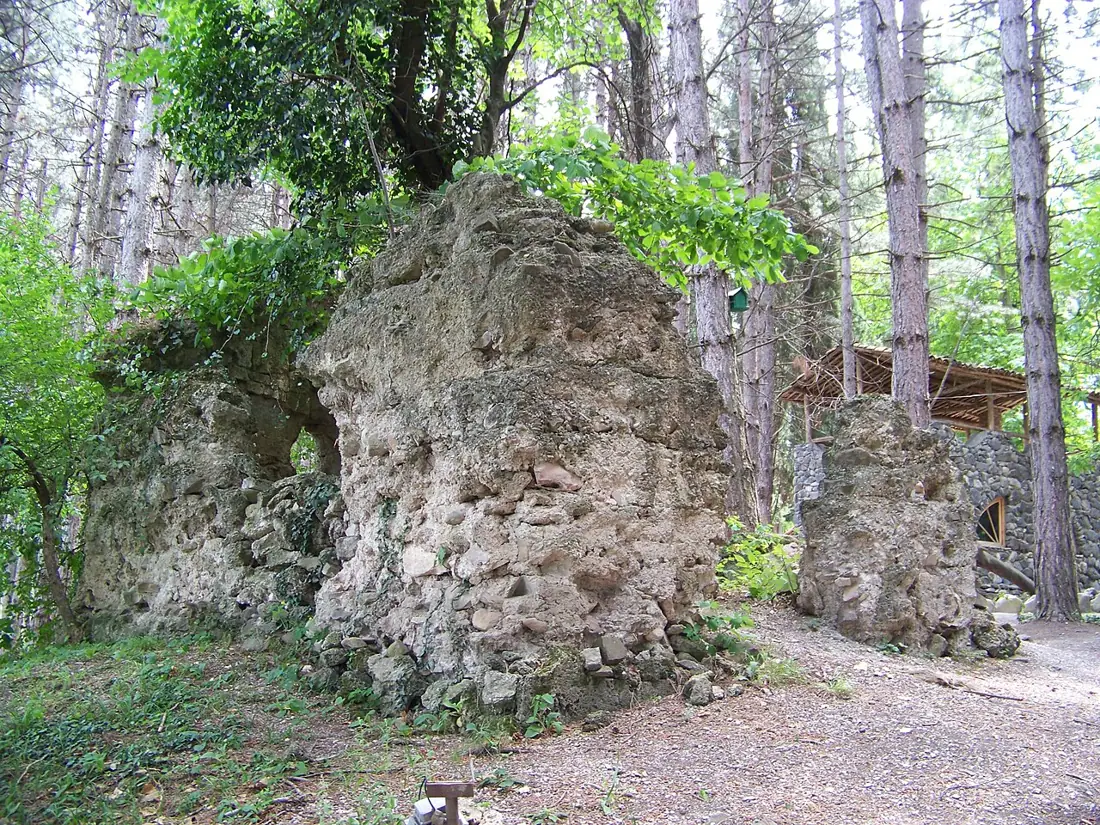
In the early medieval period this was one of the seats of the dukes of Kakheti. Chronicles refer to Kvetera as a town between the 8th and 10th centuries; afterwards it emptied and the forest took it back. Along the crest you can still trace the line of the curtain wall, the footings of towers and cut cisterns, all half-buried in grass and oak roots.
The reason to come, though, is the church. This 10th-century tetraconch measures only about five or six metres across inside — a chapel for a ruling family rather than a congregation. Its proportions are so exact that photographs give no sense of scale; arriving in person, most people are surprised by how small it is.
The dome is covered in blue-green glazed tiles. That is a later restoration rather than the original finish, and purists find it artificial, but the blue cone visible through green forest has become the image by which Kvetera is known.
Inside there is almost nothing: bare stone, one icon, a candle stand. The visit is about architecture. This is the Georgian domed church reduced to its essentials and executed without a single wasted line, and it is far easier to read here than in the large cathedrals down in the valley. Half an hour on this hill teaches more than a guidebook chapter.
The hill is easy to underestimate from the road below. Kvetera's defensive value lay in watching the whole approach to the upper Alazani, and once you are standing on the crest the reason the dukes chose this particular knoll becomes obvious within a minute.
Gallery
Practical advice
An hour covers the church and the wall remains. The last kilometre is a steep gravel track that an ordinary car may not manage after rain — either bring clearance or park lower and walk the final stretch, which takes about twenty minutes. The church is usually open and there is no ticket. Dress rules apply. Toilets and shops are in Akhmeta. Ticks are present in the forest in summer, so long trousers are worth wearing on the walk up.
How to get there from Tbilisi
From Tbilisi drive over the Gombori Pass to Telavi (95 km), then west along the Alazani towards Akhmeta. Shortly before the town turn south at the sign for Kvetera; the last two kilometres climb the hill on gravel. Total 120 km, about two hours twenty. Fuel is available in Telavi and Akhmeta. In dry weather an ordinary car will get up; after rain an SUV is the sensible choice, and in winter the track can hold ice into the afternoon.
Click a marker for details. Coloured lines are ready-made road trips.
Nearby places
 Monastery
Alaverdi Cathedral
An eleventh-century cathedral rising fifty metres out of the Alazani plain — for centuries the tallest building in Georgia.
 Nature
Batsara Reserve
The largest natural yew grove in the world, hidden in a narrow river gorge north of Akhmeta.
 Nature
Pankisi Gorge
The upper Alazani valley north of Akhmeta, home to the Chechen-speaking Kists for nearly two centuries.
 Monastery
Ikalto Academy
A sixth-century monastery with the ruins of a medieval academy where, by tradition, Shota Rustaveli studied.