Ertatsminda Cathedral
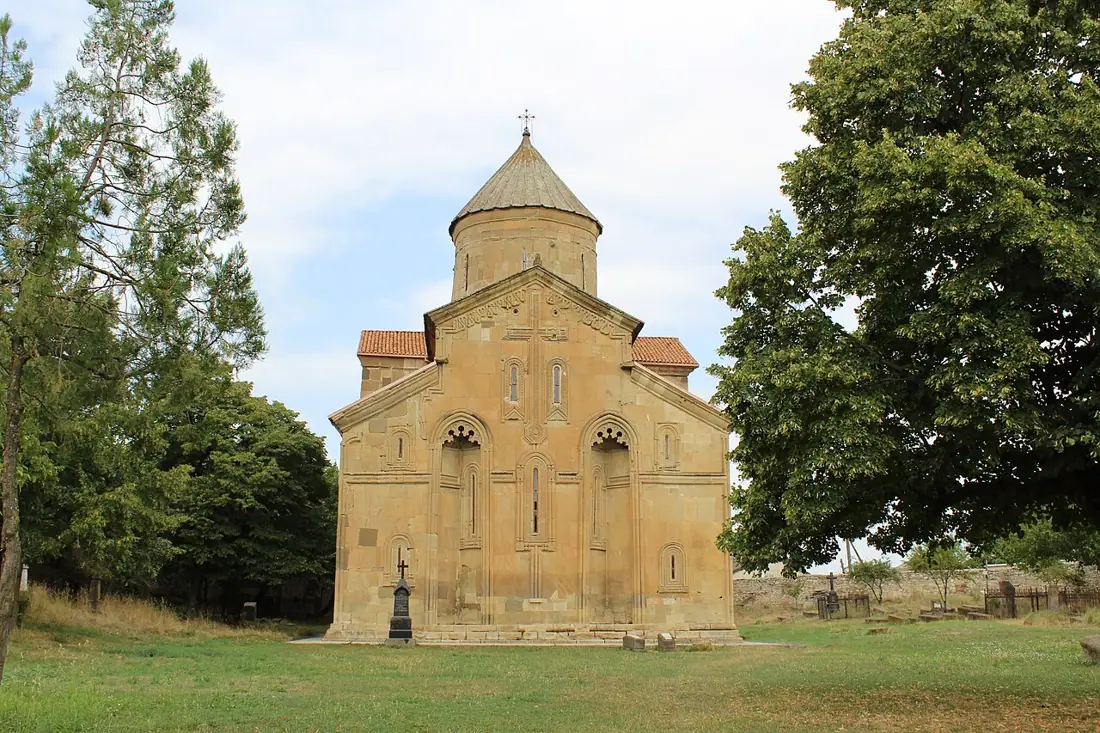
A 13th-century domed church south of Kaspi, richly carved outside and tied by tradition to the grave of Giorgi Saakadze.
- Time needed
- 1 h
- From Tbilisi
- 60 km · 1:10
- Road
- Paved
- Car needed
- Economy class
- Season
- All year
- Entry
- free
Ertatsminda is one of the best-preserved 13th-century churches in Shida Kartli. It is dedicated to Saint Eustace — Evstatetsminda in Georgian — and the village took its name from the church rather than the other way round. The whole complex sits inside a low wall among trees, in a village folded into the hills south of Kaspi.
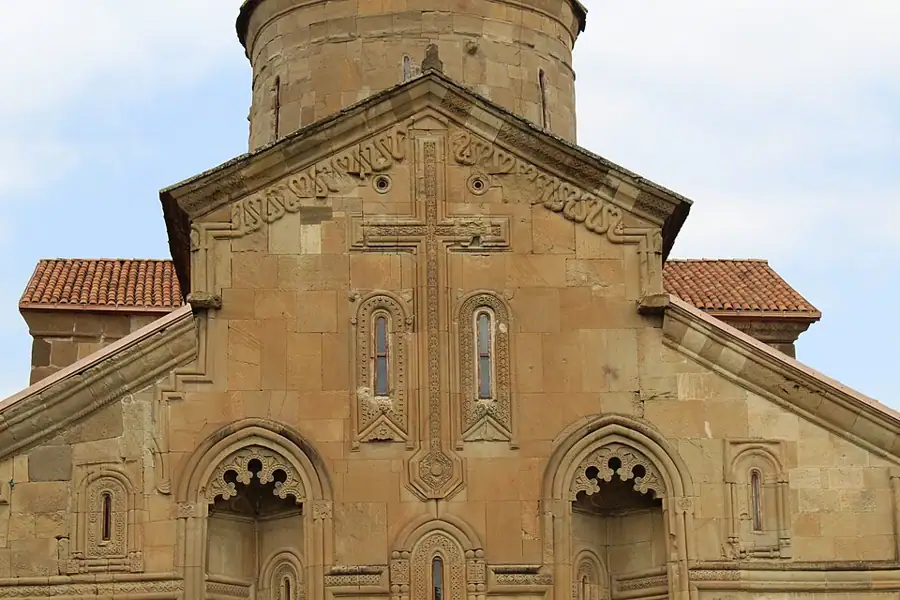
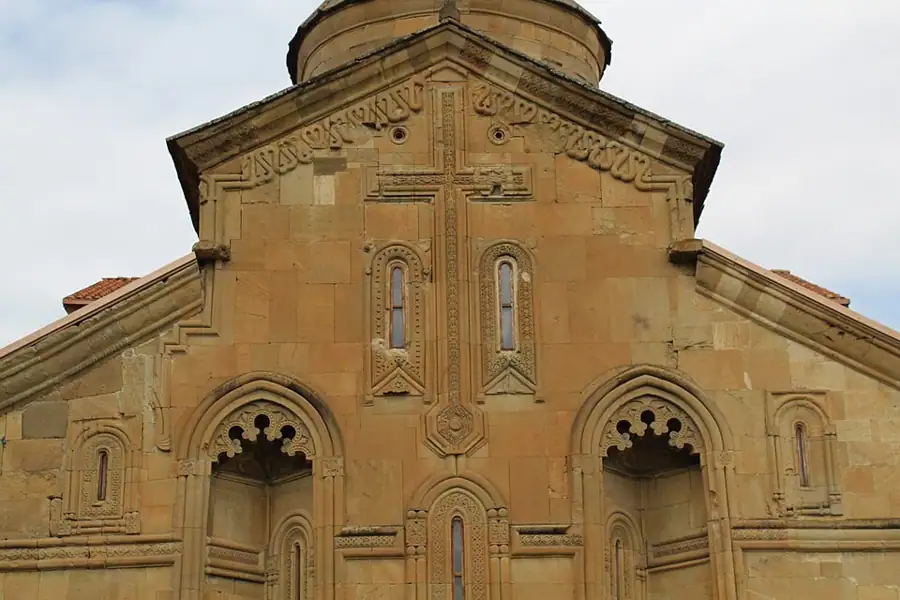
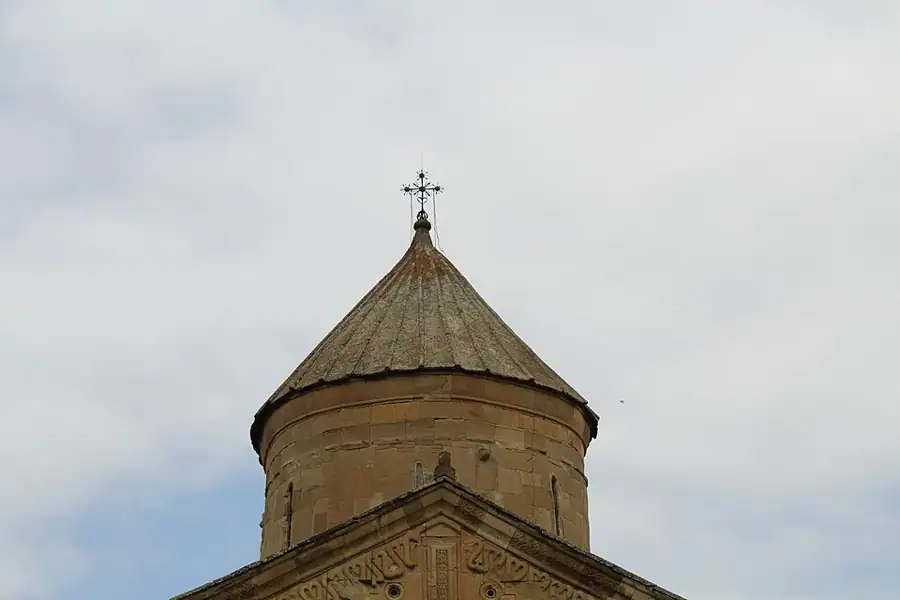
The building is a cross-in-square church with unusually elongated proportions. The east facade carries the richest work: an ornamental cross, an elaborate window surround, and a band of geometric interlace that belongs to the best tradition of medieval Georgian stone carving. The drum is tall and almost entirely covered in decoration. That verticality is precisely what separates the 13th century from the lower, heavier churches of three hundred years earlier.
The church has been damaged and repaired many times. A bell tower was added in the 19th century and the interior was replastered then, so almost no old painting is visible inside. What remains is a high, calm volume with light falling from the drum.
Ertatsminda also carries a piece of Georgian memory. Tradition holds that Giorgi Saakadze, the Great Mouravi, is buried here — the 17th-century commander who fought the Persians, then served them, then turned against them again, and was executed in Anatolia. His remains are said to have been brought home in 1629 and laid in this church. No document proves it, and historians treat the story carefully, but for Georgian visitors that is the reason the place matters.
Gallery
Practical advice
An hour covers it. The church is in use and normally open; if the door is locked, the keyholder lives in the village and asking at a nearby gate usually works. Standard dress rules apply — a scarf and long skirt for women. The ground inside the enclosure is uneven and stones hide in the grass. There are no toilets or cafes in the village, so stop in Kaspi or at the roadside places near Igoeti. In winter the village lanes turn to mud.
How to get there from Tbilisi
Take the E60 from Tbilisi towards Gori as far as Igoeti, about 40 km, then turn south on the Kaspi-Ertatsminda road. Sixty kilometres in total, roughly an hour and ten minutes. The whole route is asphalt; the last twenty kilometres are a narrow rural road with frequent bends and some potholes, but nothing an economy car cannot handle. Fuel is available at Igoeti or in Kaspi. There is a small square in front of the church where you can leave the car for nothing.
Click a marker for details. Coloured lines are ready-made road trips.
Nearby places
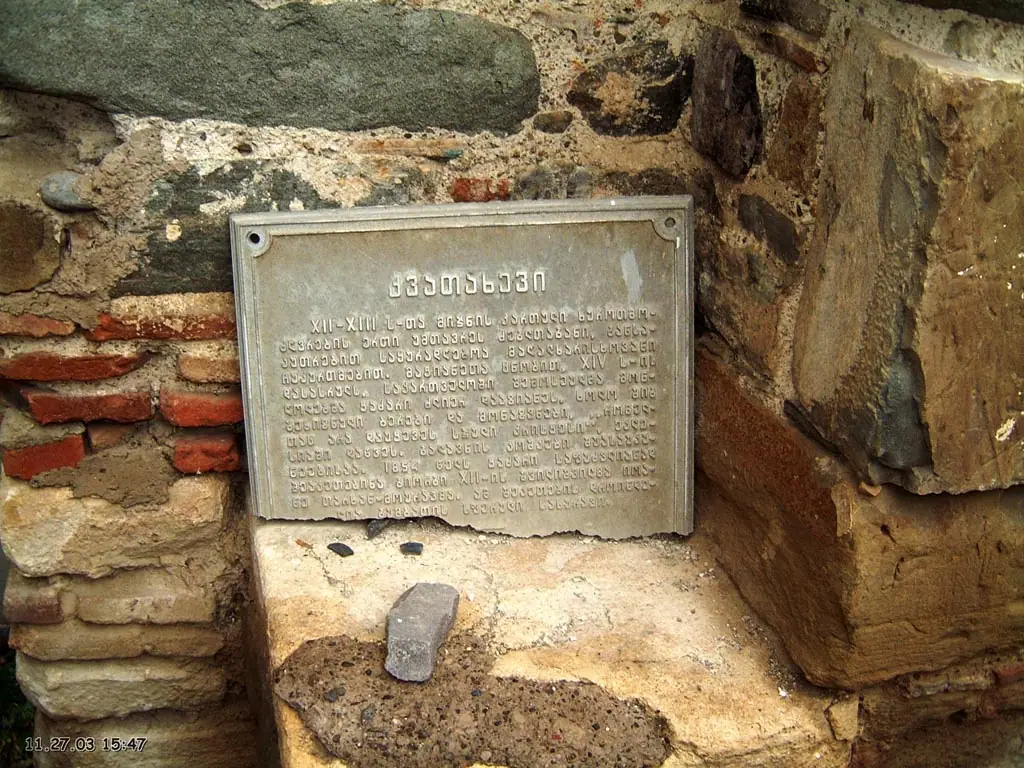 Monastery
Kvatakhevi Monastery
A domed church of the 12th and 13th centuries in a wooded gorge above Kavtiskhevi, carrying a hard memory of Timur's invasion.
 Monastery
Samtavisi Cathedral
A cathedral of 1030 near Kaspi — the benchmark of Georgian facade decoration, copied for two centuries afterwards.
 Monastery
Rkoni Monastery and Tamar's Bridge
A medieval monastery at the head of the Tedzami gorge, with a single-arch stone bridge among the best preserved in Georgia.
Booking and enquiries
This site is informational — there is no online payment. Call or email us to book.