
Vartsikhe Fortress
Ruined walls on the Rioni where Byzantines fought Persians over 'the city of the rose' and Imereti's last king made his stand against Russia in 1810.
- Time needed
- 1 h
- From Tbilisi
- 220 km · 3:10
- Road
- Paved
- Car needed
- Economy class
- Season
- All year
- Entry
- free
Vartsikhe means 'fort of the rose' — a Georgian echo of Rhodopolis, 'the city of the rose', which Byzantine historians were writing about in the 6th century.
The site lies low in the Imereti lowlands, about 80 m above sea level, where the Khanistskali meets the Rioni. Archaeology puts a fortified settlement here from the 4th century. Rhodopolis was a rich town of Lazica on the road east to Iberia, but it sat on an open plain, and that was its weakness: in the 530s the Lazi pulled down its walls themselves rather than leave the Persians a stronghold. During the Lazic War the Persian commander Mihr-Mihroe garrisoned it anyway. In 557 the East Roman general Justin sent 2,000 horsemen under a Hun named Elminzur, who rode in unopposed — the garrison and the townspeople happened to be outside the walls. For a time Rhodopolis was a bishopric under Phasis; the see fades from the records in the early 8th century, after the Arab invasions.
Centuries later the ruin became a royal castle and summer residence of the kings of Imereti, who hunted in the neighbouring Ajameti forest; Alexander V (r. 1720–1752) had it refurbished. It was badly damaged in 1771, during Count Totleben's campaign against the Ottomans. In 1809, with Russian troops already quartered in Kutaisi, King Solomon II left his capital and dug in here. Vartsikhe fell on 6 March 1810; before the year was out, Imereti had been annexed by Russia, and the castle was left to the weeds.
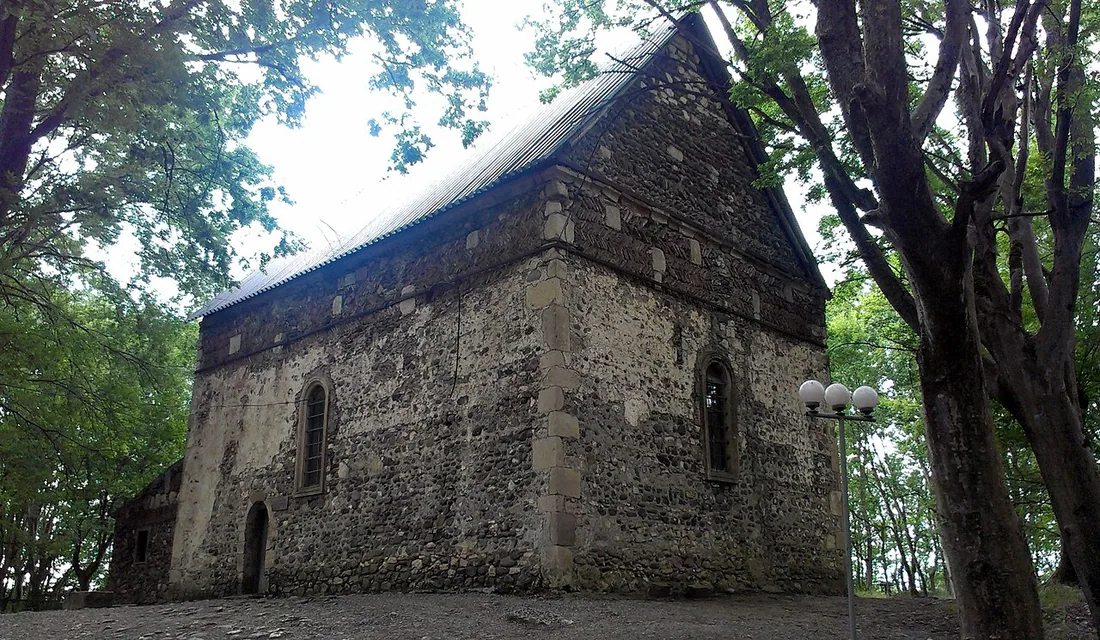
What stands today are walls of the royal period; the 4th–6th-century fortifications lie underground, studied by archaeologists in the 1970s. There is little to read on site — only stone, river light and the oaks of Ajameti beyond. It is enough. This is where the last king of an independent Imereti made his stand behind stone walls.
Practical advice
Entry is free and the ruin is unstaffed: no ticket office, no toilets, no café, and very little signage. An hour is plenty. The walls are unrestored — wear shoes with grip and keep children off the crumbling tops. Summer in the lowlands is hot and humid; come in the morning or late afternoon, when the light on the river is kinder. The village also has a long winemaking story: early in the 1900s the Ananovs, a Kutaisi family of entrepreneurs, built a winery here and bottled a local brandy that is still made, and the Chateau Vartsikhe winery sits close by — check its tasting hours in advance, and let the driver abstain.
How to get there from Tbilisi
Vartsikhe is about 220 km from Tbilisi, roughly 3 hours 10 minutes. Follow the S1 (E60) west past Gori and Khashuri, over the Rikoti section and past Zestaponi; fuel is easy all the way. Shortly before Kutaisi leave the S1 for the Sh14, the Kutaisi–Baghdati road, and after a few kilometres turn onto the Sh51 (Vartsikhe–Rokhi) into the village, which lies about 15 km from Kutaisi. The whole route is asphalt and a short walk leads from the parking to the ruins, so an economy car is all you need. Baghdati and the Geguti palace ruins are nearby for a longer Imereti loop.
Click a marker for details. Coloured lines are ready-made road trips.
Nearby places
Geguti Palace
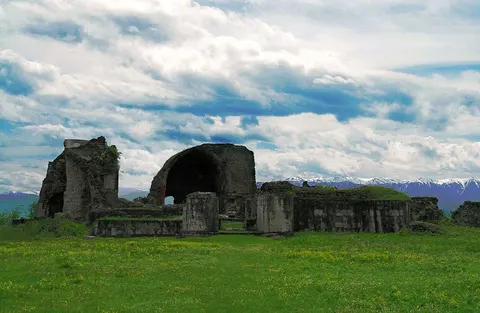
Brick ruins of George III's great palace on the Rioni plain south of Kutaisi, where in 1191 rebel nobles crowned a rival to Queen Tamar.
Baghdati — Mayakovsky House-Museum
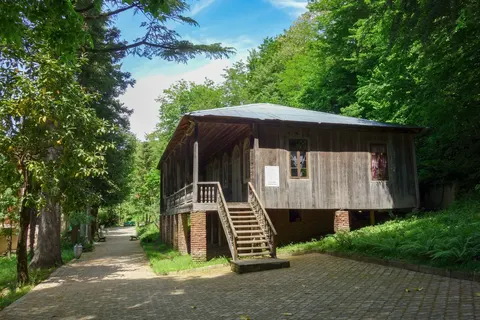
The forester’s house in Baghdati where Vladimir Mayakovsky, the loudest poet of the Russian avant-garde, was born and learned Georgian.
Best car for this trip
Guides
- Driving in Georgia: What the Distances Actually Cost You Georgia is a small country with slow roads. Here is what 267 measured drives from Tbilisi say about how long y
Pickup locations
Car Rental in Kutaisi — 14 km (straight line)