Dartlo
The most photographed village in Tusheti, terraced above the Pirikiti Alazani with slate roofs and restored towers.

- Time needed
- 4 h
- From Tbilisi
- 228 km · 7:00
- Road
- 4x4 only
- Car needed
- Off-road 4x4
- Season
- June–September
- Entry
- free
Dartlo is the image most people carry away from Tusheti, and the reason is obvious on arrival. The village is built in terraces on the left bank of the Pirikiti Alazani; stone houses stand one above another, every roof laid in flat slate, and square defensive towers rise between them.
The towers date from the 16th to 18th centuries and were built against Dagestani raiding parties who crossed the ridge each summer. The ground floor held livestock, the middle floor the family, the top floor was for watching and shooting. Several have been rebuilt over the past twenty years with international funding, using the original dry-stone technique rather than mortar, and the work is good enough that it takes a second look to tell old from new.
In the middle of the village stands the sabcheo, a half-circle of stone benches where the council of elders sat and settled disputes. It is not a reconstruction: the stones sit where they have sat for centuries.
Above Dartlo, an hour of steep climbing, is Kvavlo, an abandoned hamlet with one surviving tower and a view down the whole valley. If you have a single spare day in Dartlo, that is the walk to do.
The village lives only in summer. Families come up in June after the flocks and go back down to the plains in October — Tush shepherding still runs on that seasonal migration, with sheep walked hundreds of kilometres each way. In winter Dartlo is empty, snowed in and unreachable.
Beyond Dartlo the track continues up the gorge to Chesho, Parsma and Girevi, each smaller and emptier than the last, until the road stops short of the Chechen border. Walking or riding that stretch is the reason a good many people come to Tusheti in the first place.
Practical advice
You need to stay overnight; getting here and back in a day is not realistic. Guesthouses operate from June to September and booking is advisable, though phone coverage is patchy and messages often go unanswered. Power comes from solar panels and generators, so charge everything when you can. There is no ATM and effectively no shop, so bring cash. Spring water is clean and drinkable. Nights drop to 5-8°C even in July, so bring a warm layer.
How to get there from Tbilisi
From Tbilisi to Telavi over the Gombori Pass (95 km), then asphalt as far as Pshaveli. From Pshaveli the gravel begins, climbing the Abano Pass at 2,850 m and descending to Omalo; that whole section takes about five hours. From Omalo it is a further 15 km along the gorge to Dartlo, roughly an hour, with river fords on the way. Total 228 km and around seven hours. Only by 4x4. The last fuel is at Pshaveli.
Click a marker for details. Coloured lines are ready-made road trips.
Nearby places
 Mountain
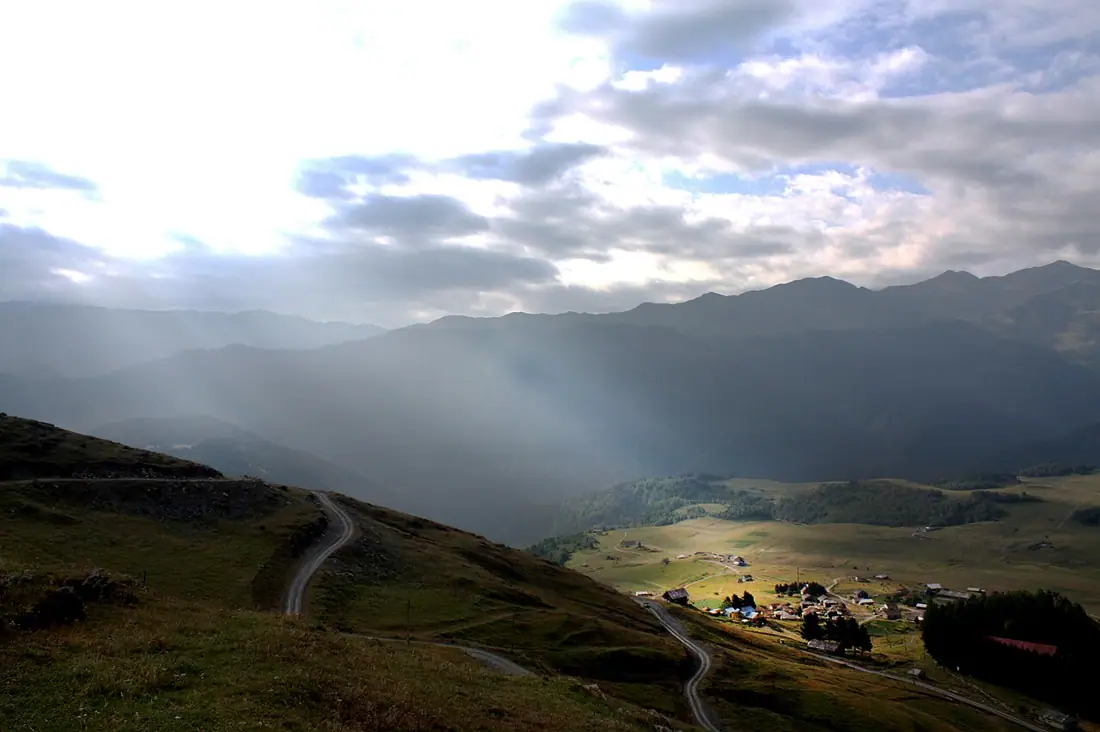
Omalo and Tusheti
Georgia's most isolated mountain region, beyond the Abano Pass — 4x4 only, and only from June to October.
 Town
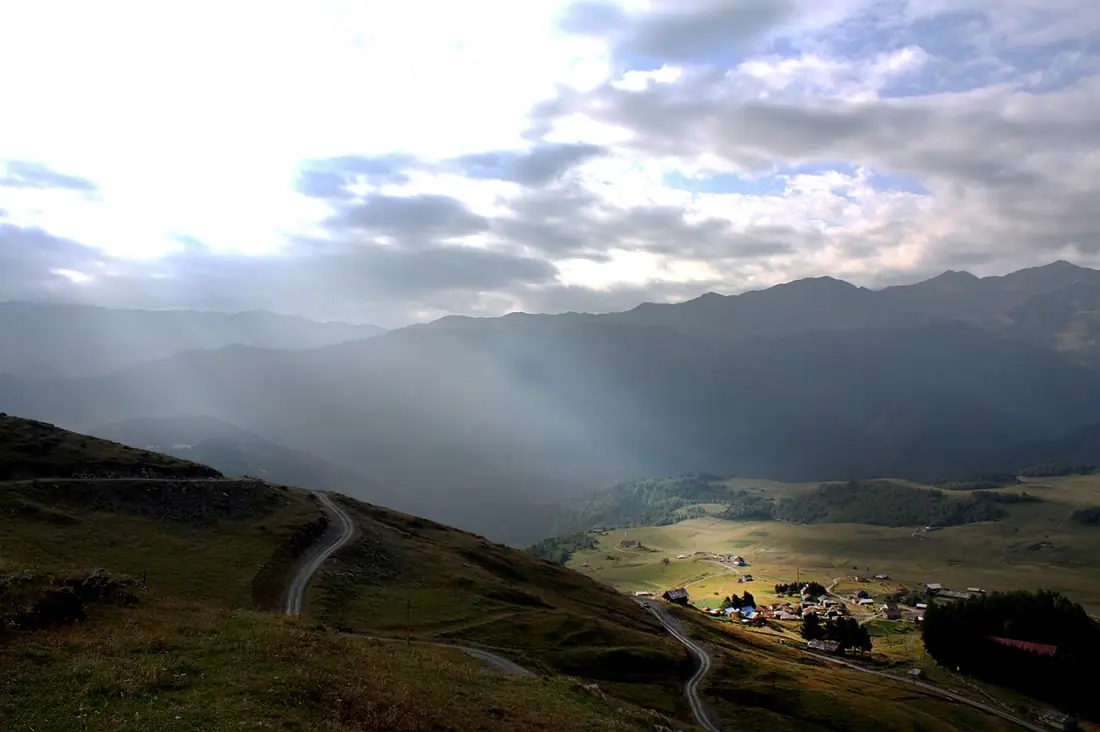
TownShenako and Diklo
The eastern villages of Tusheti in the Gometsari valley, with a red-roofed church and a fortress on the Dagestan border.
 Mountain
Abano Pass
The only road into Tusheti, crossing at 2,850 m, open roughly June to October and passable only by 4x4.