Akhali Shuamta
A working 16th-century nunnery founded on a queen's vow, two kilometres from the old churches of Dzveli Shuamta.
- Time needed
- 0.5 h
- From Tbilisi
- 88 km · 1:40
- Road
- Paved
- Car needed
- Economy class
- Season
- All year
- Entry
- free
Akhali Shuamta was founded in the middle of the 16th century and is still a working convent. Its founder was Queen Tinatin, wife of King Levan of Kakheti, a daughter of the ruling house of Guria who was travelling east to her wedding when she first saw this slope.
The tradition told here is that as a child she dreamed of a hillside and a bramble bush, and vowed to build a church wherever she found them. On the road to her marriage she recognised the place and kept the promise. The dream is not in the documents, but Tinatin's patronage is, and so is her burial in the church she paid for.
The building is brick, which is unusual in a region where stone dominates, and follows a cross-in-square plan with a tall, narrow drum. Inside there are fragments of 16th-century painting including donor portraits, darkened by candle smoke but legible. The queen's grave slab lies near the front of the nave.
The enclosure wall, refectory and cells came later and are kept in good order today: roses, walnut trees and a small vineyard worked by the community. The nuns paint icons and tend the garden, and on an ordinary weekday the only sounds are birds and your own steps on gravel.
Set against Dzveli Shuamta up the road, everything here is later, lighter and alive. That contrast is the reason to see both: two kilometres apart and about a thousand years, one abandoned to the forest and one still keeping its hours.
The church was also a political statement. Levan ruled a kingdom squeezed between Safavid Persia and the Ottoman advance, and building in brick in the manner of the eastern courts, while dedicating the work firmly to the Georgian church, was a way of holding both positions at once.
Gallery
Practical advice
Half an hour is enough. This is an active monastery and the dress code is enforced rather than suggested: long skirt and headscarf for women, long trousers for men. Wraps are often available at the gate, but not always. Photography inside the church is normally not allowed, so ask before raising a camera. Parking in front of the wall is free. There are toilets but no cafe. Quiet voices and silenced phones are the expectation, and visitors who ignore that are asked to leave.
How to get there from Tbilisi
The approach is the same as for Dzveli Shuamta: east from Tbilisi past Ujarma and over the Gombori Pass towards Telavi, 88 km and about an hour and forty minutes. The asphalt is good throughout. The monastery turning is on the left about three kilometres beyond the Dzveli Shuamta junction, and the final two hundred metres is a narrow but surfaced drive. An economy car is fine. In winter, after snow on the pass, winter tyres or chains make the descent much easier.
Click a marker for details. Coloured lines are ready-made road trips.
Nearby places
Dzveli Shuamta
Three early Christian churches standing together in Gombori forest, a short way before Telavi — quiet and very old.
 Town
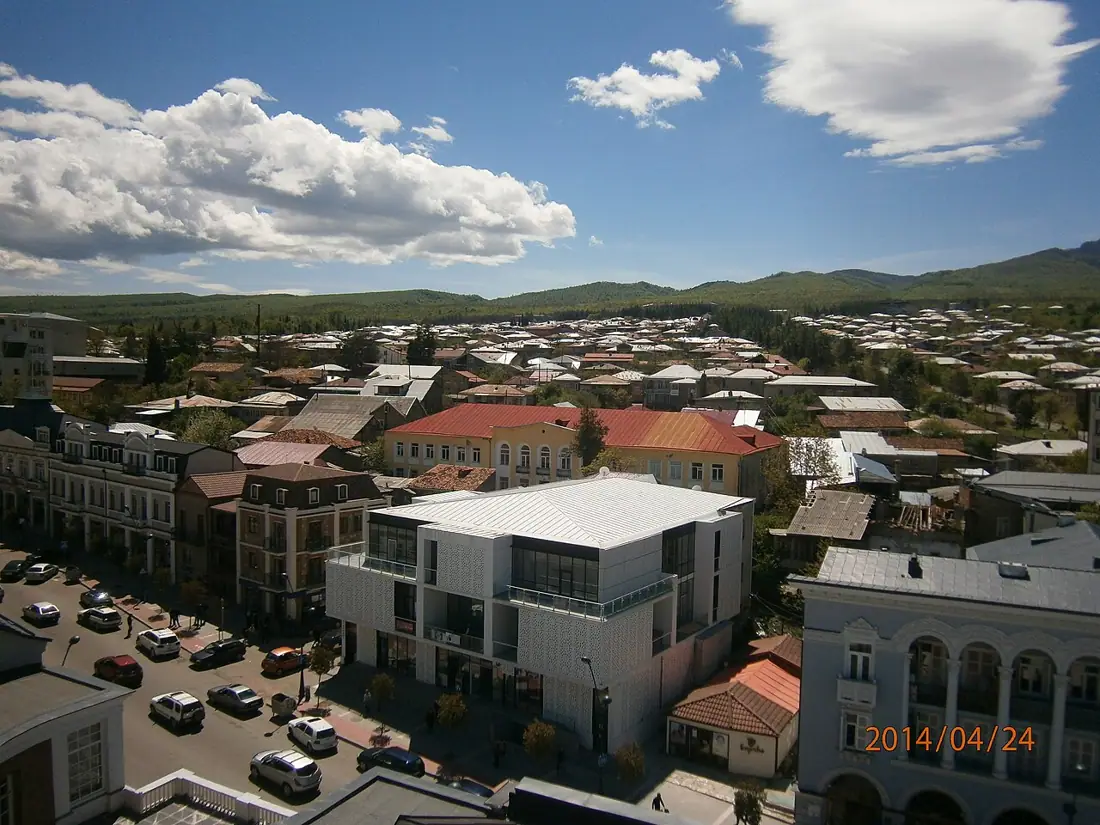
TownTelavi and Batonis Tsikhe
The capital of Kakheti on a terrace above the Alazani Valley, with King Erekle II's residence and a nine-century-old plane tree.
 Monastery
Ikalto Academy
A sixth-century monastery with the ruins of a medieval academy where, by tradition, Shota Rustaveli studied.